

Manifesto
Introduction
Opting out of income tax. It's not just for millionaires.
Is your annual adjusted gross income $75,000 or more? Then congratulations: you're part of Club 75. You're part of the 29% that's paying 90% of all federal income tax. (Source: IRS Publication 1304 for tax year 2019, Table 1.1)
We're the Club 75 Alliance. We understand the problem with income tax. It benefits the majority at the expense of a minority. And you're part of that minority.
We have ambitious plans. We want to help people opt out of income tax, across the country and across the world.
Notice we said opt out. We didn't say dodge or escape. If you're looking for help with tax evasion, you've come to the wrong place. Opting out is the legal path. Here's the current procedure: move to a country that has no income tax, and renounce your US citizenship.
Millionaires can already opt out fairly easily. We want to make it a realistic option for the rest of us. To that end, we plan to concentrate Club 75 folks in New Hampshire, and then negotiate the state's peaceful secession from the US. Once that's done, people from all over the world will be able to opt out of income tax by moving to New Hampshire.
Notice we said negotiate. We're not proposing unilateral secession, which was attempted in 1860 and ruled illegal in 1869 as part of Texas v. White. If you're looking for help with taking on the US military, you've come to the wrong place. To make secession legal, we're first going to propose a US constitutional amendment to allow a state to secede when the federal government no longer has the consent of the governed in that state. We'll use Article 50 of the Treaty on European Union as a model for this amendment.
It's a long shot. But even if we don't achieve secession, we'll prompt a long overdue worldwide discussion about income tax, income redistribution and welfare.
Actually, we'll need you to opt out of welfare and other positive rights like free education. If that doesn't scare you off, we invite you to move to New Hampshire and help us make history.
Progressive Popularity
Earlier we said income tax benefits the majority at the expense of a minority. Let's start with the first part: income tax benefits the majority. In other words, the majority pay less under an income tax than they would under some other tax raising the same amount of total revenue.
Throughout this discussion, "income tax" refers to a tax on personal income. It's usually progressive, meaning those with higher income pay a higher tax rate. In the United States for example, here are the 2022 tax rates on ordinary income for single taxpayers: (source)
| threshold | rate |
|---|---|
| $0 | 10% |
| $10,275 | 12% |
| $41,775 | 22% |
| $89,075 | 24% |
| $170,050 | 32% |
| $215,950 | 35% |
| $539,900 | 37% |
The first $10,275 of income (after any deductions) are taxed at 10%. Above $10,275, income up to $41,775 is taxed at 12%. Above that, the rate jumps to 22%. And so on. This progressive structure, along with the standard deduction of $12,950, is designed to give a break to low-income folks, who make up the majority.
It would be difficult for any other tax to be progressive in this way. Imagine trying to do the same thing with a sales tax. When you purchased something, the store would have to search a database somewhere to retrieve your total purchases everywhere so far that year, to determine the appropriate tax rate. It would be an enormous burden on merchants.
An example will help illustrate the comparison between income tax and sales tax. Consider 19 hypothetical taxpayers, one from every 5th percentile of income, labeled A through S:
| label | percentile | gross income |
|---|---|---|
| A | 5% | $2,040 |
| B | 10% | $8,801 |
| C | 15% | $15,000 |
| D | 20% | $20,000 |
| E | 25% | $25,000 |
| F | 30% | $29,052 |
| G | 35% | $32,282 |
| H | 40% | $37,000 |
| I | 45% | $41,000 |
| J | 50% | $46,001 |
| K | 55% | $50,351 |
| L | 60% | $56,536 |
| M | 65% | $62,306 |
| N | 70% | $70,165 |
| O | 75% | $80,002 |
| P | 80% | $92,200 |
| Q | 85% | $108,026 |
| R | 90% | $132,676 |
| S | 95% | $186,006 |
Here's a chart showing each taxpayer's gross income and income tax, based on some assumptions detailed in a spreadsheet:
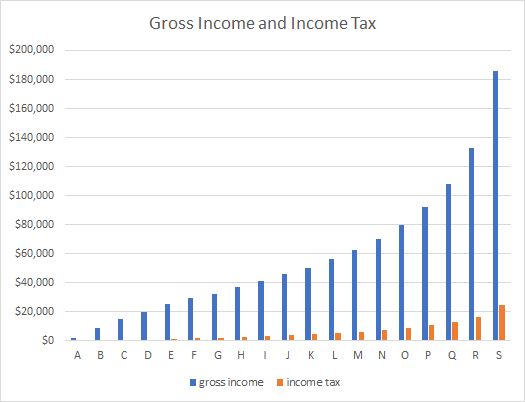
Now let's look at how the income tax compares to a sales tax raising the same amount of total revenue. Again, we're making some assumptions that you can review in the spreadsheet.
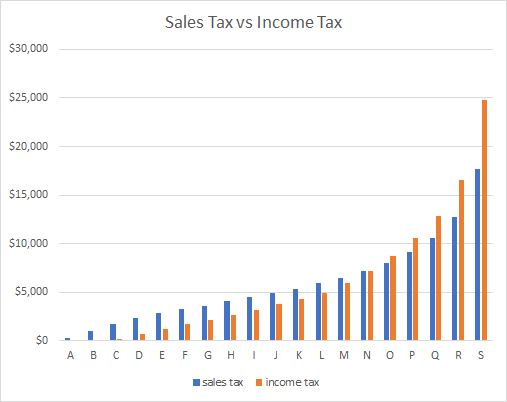
A through M would pay more under the sales tax, while O through S would pay more under the income tax. For N, the two taxes would be nearly the same. Thus, if the taxpayers carefully reviewed the data and voted in their own self-interest, there would be 13 votes in favor of the income tax, 5 in favor of the sales tax, and 1 toss-up.
The FairTax is a proposed national sales tax that would include a "prebate" of the tax on spending up to HHS poverty guidelines. For now, let's just make a simple adjustment to our model to include a prebate with the sales tax:
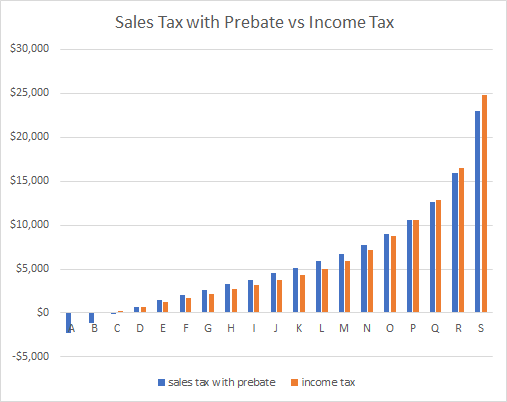
With the prebate, the sales tax now looks good at the low end (A, B, C) and at the high end (Q, R, S). The income tax looks good in the middle (D through O). For P, it's about a wash. So the votes in this case would be 12 for the income tax, 6 for the sales tax with prebate, and 1 toss-up.
Of course, the model described in our spreadsheet is quite simplistic. We still think a majority would pay more under the FairTax, but proving this rigorously would require a more extensive study, taking other factors into account such as FICA payroll tax (replaced under the FairTax) and the Earned income tax credit.
Some countries have a flat-rate income tax. For example, Estonia taxes personal income at a flat rate of 20%. But their tax is still considered progressive because of exemptions. Even a true flat-rate tax would probably benefit the majority, because high income people don't spend nearly all of their earnings. They save, invest or donate a significant portion.
When we learn that something benefits the majority at our expense, it's tempting to be angry or resentful. But anger clouds the mind. Better to focus on objective reality, and resist the urge to assign blame. We can take a deep breath, and observe without judgment the simple fact that income tax benefits the majority. Consider what this implies.
It means the United States didn't take a "wrong turn" toward socialism in the early 20th century. The income tax didn't arise from some nefarious plot by the Illuminati. No, it was just voters being human. They contemplated the idea of taxing income, and most of them said quite understandably, I prefer that. It was bound to happen at some point, just as it did eventually in most countries.
It also explains why decades of efforts to repeal the income tax by the national Libertarian Party and people like Ron Paul failed, and future attempts have little chance of success. Even if voters could be briefly fooled into repealing it, they would eventually bring it back.
Human societies have a proclivity for taxing income. Fighting it through national politics is an exercise in futility. We need to adopt a different strategy.
Alice Doesn't Live Here Anymore
The Principality of Monaco has about 38,000 residents, roughly a third of whom are millionaires. Most likely they're drawn to Monaco by the absence of income tax. Let's look at a hypothetical example, an investor named Alice who has $40 million.
Alice is fictional, but she's loosely based on John Templeton, an investor who renounced his US citizenship in the 1960s and moved to the Bahamas, another country with no income tax. He donated his tax savings to charity, and went on to become one of the most generous philanthropists in history. He established the Templeton Foundation in 1987.
It's hard to find detailed financial information about John Templeton, or about some millionaire living in Monaco or the Bahamas, so we're going to make up some details about Alice. You may be wondering what's the point of this exercise. After all, we wouldn't normally feel any connection or sympathy with a real millionaire, let alone a fictional one. But as we'll see later, the income tax hurts you in the same way that it hurts people like Alice. Your dilemma is essentially the same as hers, just on a smaller scale. We'll focus on Alice's situation, because the dollar amounts there are large enough that we can clearly see what motivates her move to Monaco.
The story begins in May, 2001 with Alice making good money as a marketing executive in El Paso, Texas. A friend tells her about Hansen Natural Corporation, a juice maker planning to come out with an energy drink called Monster. She buys 50,000 shares at $3.08 a share.
Fast forward to November, 2017. Alice is retired now. Hansens Natural Corporation is now called Monster Beverage. Its stock has split four times. Alice now has 2,400,000 shares worth $62.67 each, with a total value just over $150 million. Needless to say, she's been incredibly lucky. She feels a profound sense of blessing, not only for the stock performing so well, but also for the happy circumstance that in 2001 she had $154,000 to invest along with the courage to risk that money, which at the time was a significant portion of her life savings.
She decides to sell it all and try her hand at swing trading with $40 million of the proceeds. She pays about $21 million in taxes, and donates the rest (nearly $90 million) to charities helping those who haven't been so lucky. We've put together a spreadsheet showing the details of her 2017 windfall gain.
As it turns out, Alice has a knack for swing trading. During 2018, she earns about $5.7 million, nothing so spectacular as the Monster Beverage profit, but still a respectable 14.3% return on her $40 million. She lives well, but not extravagantly, limiting her household expenses to $100,000. She wants to donate the rest to organizations in her local community helping those in need, as well as international charities like Habitat for Humanity, Rise Against Hunger and Doctors Without Borders.
But she can't give it all away, because some of it has to go to taxes. Let's look at her federal income tax for 2018:
| $5,709,196.23 | gross income |
| $3,425,517.74 | charitable deduction = 60% of gross income |
| $2,283,678.49 | taxable income = gross income - charitable deduction |
| $810,650.54 | regular tax = 37% of taxable income - $34,310.50 |
| $209,349.46 | net investment income tax = 3.8% of (gross - $200,000) |
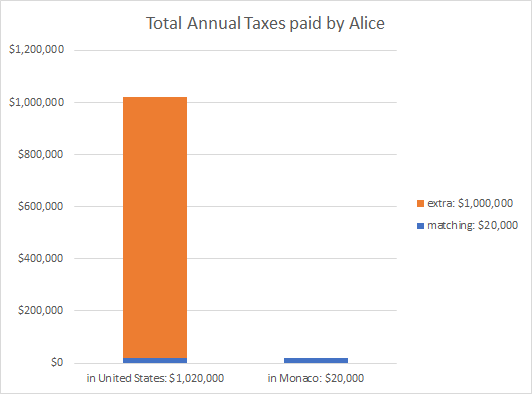
| $1,020,000.00 | total tax = regular tax + net investment income tax |
Alice realizes she could save on future taxes (assuming similar income) by living in Monaco, which has no income tax and no property tax either. If she lived there, she'd only have to pay the Value Added Tax of 20% on her household expenses. That comes to $20,000. She puts together a chart showing the dramatic tax savings, and talks it over with her friend Edith.
Edith points out that in order to get the tax benefit, Alice will need to renounce her US citizenship. It takes 10 years to become a citizen of Monaco, so if she doesn't want to wait that long, she'll first need to become a citizen of some other country like Singapore, Portugal or Malta. This isn't terribly difficult for a multimillionaire like Alice with no criminal record, but it does take a few years, and it means she might not be allowed to visit the US in the future, because of the Reed Amendment.
Edith tries to talk Alice out of making the move, but struggles to find any tangible downside. Monaco has a mild climate, and it's one of the safest places in the world. The country offers a lot of the same freedoms that Americans enjoy, although marijuana is currently illegal there, as is same-sex marriage.
Finally, Edith says what's really on her mind: Alice, I'm sure you know the government does a lot to help the poor, with programs like Temporary Assistance for Needy Families, the Supplemental Nutrition Assistance Program, and the Earned Income Tax Credit. Can't you think of your taxes as just one more way to help those less fortunate? Isn't that something you want to do anyway?
Alice replies that she would rather donate the money to suitable charities, for three reasons:
- efficiency
- Suppose Alice stays in the US and pays that $1 million a year in the form of taxes, thinking of the government as a charity. What percentage of that money will actually go to help those in need? In the Federal Budget Historical Tables, section 11 covers Payments for Individuals. In 2018, the on-budget portion was 59% of the total. The other 41% went to other things like the military and paying interest on the national debt. Of course, Alice has no way of verifying how much of Payments for Individuals actually helps people in need, but even if all of it does, that's only 59%. In contrast, Habitat for Humanity puts 78% of their budget toward their program of helping to build homes for people. Alice's other charities have even higher Program Expense Percentages.
- priority
- If Alice stays in the US, even the 59% of her taxes that become Payments for Individuals are almost all paid to Americans. But Alice may want to make a substantial contribution in those areas of the world where the need is greatest, like India and Bangladesh where there's a lot of poverty. Of course, she'll also want to focus on her local community, but that doesn't necessarily relate to national boundaries. Since she lives in El Paso, she's a lot more likely to think of Ciudad Juárez as part of her community than Boston.
- acknowledgment
- Even if we say that poor people in the US are higher priority than those in India, Bangladesh or Mexico, still, those receiving assistance are led to believe the money came from the government. If they thank anyone at all, they might thank their favorite politician, someone like Bernie Sanders. It won't even occur to them to thank taxpayers like Alice, who could have moved to Monaco, but chose not to.
Alice wants to be clear about one thing: Edith, I'm not criticizing the US government. I'm not saying they should trim their military budget for better efficiency, or increase aid to countries with extreme poverty for better priority, or start sending thank-you notes to taxpayers for better acknowledgment. What I'm saying is, it doesn't make sense to think of the government as a charity at all. It's not a charity. It's a government. So it makes sense for each of us to save money on taxes using whatever legal means are available. You save money by deducting your home mortgage interest. I'll save money by moving to Monaco.
Alice decides to proceed with her plan. She first moves to Malta, where the government is putting together a new Citizenship by Investment program. Finally passed in 2020, the program allows her to become a citizen in just 12 months, at a total cost of about $1 million. Once she has her Malta passport, she can renounce her US citizenship and then relocate to Monaco. She'll maintain her residence in Malta, but she'll be "non-domiciled" there.
One part of this story that may be especially hard to believe is that Alice would want to donate over 97% of her income to charity. We deliberately portrayed her that way, to illustrate the point that even a very altruistic person can still have a big reason to move to Monaco. But now let's consider someone who's more selfish. Suppose Alice has a friend Bob who has similar income but doesn't care about the poor at all. He likes to spend his money on fast cars. His taxes in the US are higher because he doesn't get any deduction for charitable contributions. His taxes in Monaco would also be higher because the Value Added Tax would apply to his cars also. Even so, as this spreadsheet shows, Bob would actually save even more money than Alice by moving to Monaco. Later when we discuss the morality of millionaires moving to Monaco, we'll examine whether Alice and Bob should be judged differently.
Pondering the Emirates
Now let's turn our attention to Cathy, a freelance software developer. She's another fictional character, but her tax situation is probably closer to yours.
Cathy works from home as an independent contractor, developing web applications for clients who could be anywhere in the world. Her gross income is $83,000 a year. Her federal income tax for 2022 looks like this:
| $83,000.00 | gross receipts |
| $2,000.00 | expenses for business use of home |
| $81,000.00 | net profit |
| $5,722.47 | 1/2 self-employment tax |
| $75,277.53 | adjusted gross income |
| $12,950.00 | standard deduction |
| $12,465.51 | qualified business income deduction |
| $49,862.02 | taxable income |
| $6,590.00 | regular tax |
| $11,444.94 | self-employment tax |
| $18,034.94 | total tax |
Moving to Monaco is not a realistic option for Cathy. To apply for residence, she'd normally have to deposit 500,000 euros (over $500,000) in a Monaco bank. Even if she could get around that somehow, she probably couldn't afford an apartment there with enough space for living and working.
But in the United Arab Emirates, Cathy could get a freelance permit. The country has several areas known as free zones that issue such permits. For example, Dubai Internet City offers a permit through GoFreelance that would allow Cathy to work in Dubai. She'd need to demonstrate her earning potential from freelancing. If she has existing clients that keep her fairly busy and don't mind her working from Dubai, so much the better.
There's no income tax in the UAE, but Cathy would have to pay the Value Added Tax of 5% on her household expenses. There are also annual costs associated with the freelance permit. How much she'd really save depends on her cost of living in the US. Suppose she's currently paying $1,200 a month for a two-bedroom apartment, $360 a month for health insurance, and $2,500 a month for other household expenses. Below are her annual taxes, rent and health insurance in the US. To keep it simple, we'll ignore taxes other than federal income tax.
| $6,590.00 | regular tax |
| $11,444.94 | self-employment tax |
| $14,400.00 | two-bedroom apartment rent |
| $4,320.00 | health insurance |
| $36,754.94 | total taxes, rent and health insurance |
The corresponding figures in Dubai might look like this:
| AED | USD | |
|---|---|---|
| 5,508.75 | 1,500.00 | 5% VAT on other household expenses |
| 7,500.00 | 2,042.21 | freelance permit |
| 2,000.00 | 544.59 | establishment card |
| 1,653.00 | 450.10 | residence visa |
| 25,108.66 | 6,836.94 | retirement contribution |
| 70,000.00 | 19,060.59 | two-bedroom apartment rent |
| 10,000.00 | 2,722.94 | health insurance |
| 121,770.41 | 33,157.37 | total taxes, retirement, rent and health insurance |
Since she won't be paying into US Social Security any more, she'll need to do her own retirement planning. Here she's setting aside about $6,800 annually toward retirement, which is significantly less than the self-employment tax she'd be paying in the US. We'll discuss Cathy's retirement plans more fully in a later section.
In this example, the rent on her apartment is higher in Dubai. But her health insurance is lower, because she's allowed to purchase just the catastrophic coverage she needs. Overall, she ends up saving about $3,600 a year.
We've put together a spreadsheet showing the details of Cathy's savings at her current income level, and what they would be at two higher levels. Below are the highlights.
| $83,000.00 | $110,000.00 | $137,000.00 | gross income |
|---|---|---|---|
| $2,053.10 | $5,774.10 | $9,525.10 | savings on regular tax |
| $4,608.00 | $4,372.97 | $4,137.95 | savings on retirement |
| -$4,660.59 | -$4,660.59 | -$4,660.59 | offset on rent |
| $1,597.06 | $1,597.06 | $1,597.06 | savings on health insurance |
| $3,597.57 | $7,083.54 | $10,599.52 | overall savings |
You can see that at the $83,000 level, her biggest savings come from being allowed to fund her own retirement. But at $110,000 and $137,000, the savings on regular tax become more significant.
Because Cathy is American, she has one more hurdle to overcome. She'll need to become a citizen of some other country, so she can renounce her US citizenship, to get the tax benefit as an independent contractor. It takes 30 years to become a citizen of the UAE, so most likely she'll need to look elsewhere. Portugal allows freelancing with its D7 visa, and she can become a citizen there after 6 years. Alternatively, if she can find full-time employment in Singapore, she can become a citizen there after 2 years.
Cathy will need to consider that the UAE offers significantly less social freedom than the US. Perhaps most strikingly, homosexuality is forbidden there. So not just gay marriage, but being gay at all is illegal. For what it's worth, PlanetRomeo's Gay Happiness Index ranked the country 85th out of 127, just slightly better than Russia.
Monaco and the UAE prove the feasibility of no income tax. But we want to offer folks like Cathy a better alternative. We hope to turn NH into an independent country that is not only free of income tax, but also gay-friendly and accessible to non-millionaires. In addition, new immigrants will have a realistic path to citizenship in just a few years.
Tyranny of the Majority
We've established that income tax benefits the majority, and that people like Alice and Cathy could save money by moving to a country with no income tax. There's a name for this type of situation: tyranny of the majority. This refers to the majority using the democratic process to benefit themselves at the expense of a minority.
The mere fact that a minority disagrees with a law doesn't mean the law constitutes tyranny of the majority. For example, a law that forbids parking on certain streets after 10 pm wouldn't meet the definition, no matter how much a minority might want to park there later. Indeed, every law has a minority that opposes it, unless the vote was unanimous.
Here's the acid test: suppose a lot of people who opposed the law left the country (or the jurisdiction of the law). Would either the government or the majority be materially worse off? If the answer is yes, the law may qualify as tyranny of the majority. It means the law doesn't just regulate something; it requires the minority to take some positive action that benefits the majority.
Let's look at another example of tyranny of the majority: conscription. Those drafted into military service against their will usually make up a minority even within the male population, because of the age limits, and because a significant number actually volunteer to serve. This example shows that the expense borne by the minority doesn't have to be monetary. In this case, it takes the form of being compelled to put their lives at risk in a war they may not consider just.
Now suppose a lot of folks in this minority left the country. Indeed, many young men moved to Canada to avoid serving in the Vietnam war. Clearly the government was materially worse off as a result, since they had to find other people to conscript.
In contrast, even if all the people who wanted to park on the street after 10 pm moved elsewhere, neither the government nor the majority would be hurting. They might even say, good riddance.
But if lots of people with above-average income emigrated to Monaco or the UAE, the US government would suffer a loss of tax revenue. They would lose $1 million a year for each person like Alice who left, and several thousand dollars a year for each person like Cathy.
"Tyranny of the majority" sounds judgmental, but we don't mean it that way. It's the phrase used by authors like John Adams and John Stuart Mill to describe this phenomenon, which is really a flaw in the democratic process. We're not blaming people who vote for something that benefits them. We just want a remedy. And as we'll see later, the proper remedy is secession.
Insinuated Moral Obligation
Tyranny of the majority creates an incentive for a minority to leave the country, and when some of them do so, the majority are ambivalent on how to respond. On the one hand, they believe these emigrants are shirking some moral obligation. On the other hand, they hesitate to say so plainly, because emigration is widely considered a fundamental human right. So the moral obligation is only insinuated, and not stated explicitly.
In 2004, a resident of Nelson, BC announced plans for a memorial statue honoring draft dodgers. The city received a flood of emails opposing the project, one of which ended with this sentence:
But silly people enjoying the benefits of a free society have the right to celebrate any way they choose, standing on the corpses of those brave enough to fight and die for their freedom.
Clearly the author doesn't want the statue built. But the figurative language (standing on the corpses) makes it hard to gauge precisely what the sentence is trying to say. Let's look at some possible clarifications:
- These people broke the law, so they don't deserve a memorial statue.
- President Carter pardoned the draft dodgers in 1977, so this seems like a minor technicality. Refusing to wear a face mask where required by local ordinance is also illegal. If someone ignores an unjust law, isn't that an allowable act of civil disobedience? Anyway, the email only makes a brief mention of legality: a monument honouring criminal behaviour is disgusting. The rest of the email including the quoted sentence appears to focus on morality, not legality.
- Americans have a moral obligation to serve in the military when called to do so.
- Why is the moral obligation tied to nationality? Most moral obligations such as the Ten Commandments apply to everyone, regardless of nationality. Suppose we say that mandatory military service is part of the social contract of the US. Then if someone says, I prefer the Canadian social contract, why is that wrong?
- Members of a free society have a moral obligation to serve in the military when called to do so.
- Isn't Canada a free society? How about Costa Rica, which has no military at all?
So the author insinuates a moral obligation to serve in the military, but doesn't address the key question: to whom specifically does it apply? If it only applies to Americans, then it's just a legal obligation, i.e., the majority voted to dump this obligation on a minority. If it applies to people in some countries but not others, then it's counterintuitive, because moral obligations generally don't work that way.
Now let's look at an example for income tax. Eduardo Saverin, co-founder of Facebook, renounced his US citizenship in 2011. In so doing, he may have saved tens of millions of dollars in taxes. Senator Chuck Schumer had this response:
Eduardo Saverin wants to de-friend the United States of America. Senator Casey and I have a status update for him: Pay your taxes in full or don't ever try to visit the U.S. again.
In this case, there's no legal issue at all. Saverin paid all the taxes he legally owed, including the exit tax. If there was some glitch in the tax code that allowed Saverin to pay less than what Schumer considered proper, it was up to Schumer to propose a fix. Indeed, Schumer proposed the Ex-PATRIOT Act, which ultimately failed to pass.
Schumer insinuates that Saverin had a moral obligation to pay more than what was legally required. But how much more?
Saverin was born in Brazil, and became a US citizen when his parents immigrated to Miami. But what if things had gone differently? Suppose his parents had remained in São Paulo? He could have attended Harvard University on an F-1 student visa. He could still have met Mark Zuckerberg at Harvard, made the same initial investment in Facebook, and ultimately settled in Singapore, without ever becoming a US citizen. What would his insinuated moral obligation have been then?
Some people agree with Schumer that millionaires renouncing US citizenship are dodging a moral obligation to pay their fair share of taxes. When we're debating such folks, we'll need to press them on the specifics of this insinuated moral obligation. Who all is subject to it? People in the US? How about people in Monaco or the UAE? And how much is their fair share? If we nudge these people gently but persistently, maybe they'll come to see that this insinuated moral obligation is a fiction, conjured up as a way to rationalize income tax.
Multilateral Secession
In most cases, secession is unilateral. That is, the seceding region unilaterally declares itself independent. This typically leads to war with the parent country. Examples include the secessions of the United States and the Irish Republic, as well as the attempted secessions of South Carolina and other Confederate states.
We have no desire for unilateral secession. Even if it hadn't been ruled illegal as part of Texas v. White, we still wouldn't want it. We have a specific objective: opting out of income tax through peaceful, negotiated secession. It's important to us that the US recognize NH as a sovereign nation, and we want to maintain good relations with them going forward. Any hostility would make it difficult to achieve this goal later.
We're going to use the word "multilateral" to describe this type of secession. It's the opposite of unilateral.
First we'll need to build up support for secession within the state, partly by getting Club 75 folks to move here, and partly by winning over some of the locals. Then we'll introduce a NH Constitutional Amendment Concurrent Resolution (CACR) to begin the process. Unlike CACR32 which tried to declare independence, our CACR will simply declare that the US federal government lacks the consent of the governed in NH. When this passes, we'll propose a US constitutional amendment allowing a state to secede when this condition arises.
Even if all this goes well, the terms of secession still need to be negotiated. Obviously there are a lot of details to be worked out. Here are a few of them:
- What will happen to federal land within NH, such as the White Mountain National Forest, as well as the Federal Correctional Institution in Berlin?
- Would the US consider having open borders with NH, similar to those between France and Monaco? If so, what would be the conditions? Otherwise, could we at least let drivers travel easily between Maine and Massachusetts? Perhaps Interstate 95 could remain federal property, with border controls at the on and off ramps within NH.
- Would the US consider providing national defense for NH, similar to what France provides for Monaco? If so, what would be the cost?
- Can we arrange for expedited renunciation of US citizenship? Likely hundreds of thousands will want to become NH citizens only.
Here are some issues of particular interest to Loyalists, i.e., those who voted against the CACR because they didn't want secession:
- Will NH health care providers be able to accept Medicare for US citizens?
- Will US citizens residing in NH be able to vote in US presidential elections?
- What will happen to NH branches of nationwide banks such as Bank of America headquartered in other states? Will accounts at those branches still be insured by the FDIC?
We have no illusions that this will be easy. After the CACR passes, it will likely take years before the US government is willing to discuss secession at all. We'll need to make a compelling case to the American people and to the international community that secession is warranted. Once the negotiations begin, it will be vital to maintain an atmosphere of mutual respect and cooperation. We can use the Brexit negotiations as a model.
Consent of the Governed
Take a look at this excerpt from the US Declaration of Independence:
We hold these truths to be self-evident, that all men are created equal, that they are endowed by their Creator with certain unalienable Rights, that among these are Life, Liberty and the pursuit of Happiness.— That to secure these rights, Governments are instituted among Men, deriving their just powers from the consent of the governed, — That whenever any Form of Government becomes destructive of these ends, it is the Right of the People to alter or to abolish it, and to institute new Government, laying its foundation on such principles and organizing its powers in such form, as to them shall seem most likely to effect their Safety and Happiness.
Pay particular attention to the text in bold. We believe these aren't just empty words. They mean something: when a government lacks the consent of the governed in a given region, it lacks the just powers to govern there. The original words referred to the British government lacking the consent of the governed in the colonies. But the same reasoning applies to the federal government lacking the consent of the governed in one of the states.
What level of consent is required for a just government? A simple majority? Perhaps a supermajority? Ultimately it won't matter. Passing our NH constitutional amendment will require the support of three-fifths of both the House and the Senate, as well as two-thirds of those NH voters participating in the next general election. We'll argue that meeting this threshold proves the federal government lacks any reasonable level of consent in NH.
But we're getting ahead of ourselves. Our very challenging first step will be to build up support for turning NH into an independent country with no income tax. To accomplish this we'll need to convince as many locals as we can to agree to the following statement, and we'll need to bring a whole lot of people here from elsewhere who also agree to it. We'll call this the Club 75 Alliance Personal Statement:
- I do not consent to be governed by the federal government. In particular, I do not consent to federal income tax.
- I understand and agree that obedience does not imply consent. In particular, payment of federal income tax does not imply consent to that tax. It may reflect compliance with an oath, or it may simply indicate a desire to stay out of prison.
- If I am elected to office prior to secession, I will obey my oath to support and defend the US Constitution. In particular, despite my lack of consent, I will pay federal income tax as legally required, and I will strictly follow the Constitution in any proposal for secession.
- I do not expect or want the government of New Hampshire to provide me with the positive rights described in Part 3 of the United Nations International Covenant on Economic, Social and Cultural Rights, such as the right to an adequate standard of living and the right to free education. I hereby explicitly and irrevocably opt out of these positive rights.
- I understand and agree that if I become unable to provide for myself, there is always a risk that voluntary charity may not be sufficient to keep me alive. I hereby accept this risk.
Points 4 and 5 are important for keeping the new government fiscally sound. We'll discuss them and the International Covenant on Economic, Social and Cultural Rights at much greater length in the next section.
How many people will we need to bring to NH? It depends how many locals we can win over, but it's likely to be a lot, on the order of a million people. For example, suppose we can eventually persuade one-third of current NH voters to agree to the statement. Then in order to achieve the two-thirds supermajority for the CACR, we'll need to bring in as many people as there are existing NH voters. Assuming very high voter turnout, that means we'll be doubling the NH voting age population, estimated at 1,132,616 for 2021.
This would be an unprecedented migration, likely taking more than 10 years. According to Table 1.1 in IRS Publication 1304, Club 75 included over 45 million people in 2019. We hope many of them will agree to the statement, but we don't really know. We'll focus on those who can work remotely, so they can probably keep their current jobs. Of course, some people with adjusted gross income below $75,000 may still be philosophically opposed to income tax and positive rights, and they would be most welcome.
We'll know it's time to push for secession when the list of people who have agreed to the statement includes the governor, both of our US Representatives, both of our US Senators, three-fifths of the NH House and three-fifths of the NH Senate. For the secession to have any chance, we'll need to show overwhelming support for it within the state.
For now, let's imagine that we've somehow achieved this milestone. What would come next? Our NH CACR might look something like this:
Be it resolved by the House of Representatives, the Senate concurring, that the Constitution of New Hampshire be amended as follows:
I. That the first part of the constitution be amended by inserting after article 7 the following new article:
[Art.] 7-a. [Lack of Consent of the Governed.] The people of New Hampshire have declared that the government of the United States lacks the consent of the governed in New Hampshire. Any of the United States Representatives or Senators from New Hampshire are encouraged to introduce a joint resolution proposing an amendment to the Constitution of the United States allowing a State to decide to withdraw from the Union when the government of the United States lacks the consent of the governed in that State, following the model of Article 50 of the Treaty on European Union.
...
VII. Voters' Guide.
IF THE AMENDMENT IS ADOPTED, New Hampshire will declare that the United States federal government lacks the consent of the governed in New Hampshire. Our congressional delegation will then propose an amendment to the United States constitution that will allow New Hampshire to decide to withdraw from the union. If that amendment to the United States constitution passes, New Hampshire will begin negotiations with the United States for peaceful withdrawal from the union, in a manner similar to the United Kingdom's withdrawal from the European Union.
Below is a draft joint resolution proposing our US constitutional amendment. It's taken almost verbatim from Article 50 of the Treaty on European Union, with changes appropriate for the United States.
JOINT RESOLUTION
Proposing an amendment to the Constitution of the United States, ...
Section 1. Any State may decide to withdraw from the Union when according to its own constitution, the people of that State have declared that the government of the United States lacks the consent of the governed in that State.
Section 2. A State which decides to withdraw shall notify the President of the United States of its intention. The President, or a person or persons designated by the President, shall negotiate and conclude an agreement with that State, setting out the arrangements for its withdrawal, taking account of the framework for its future relationship with the United States. That agreement shall be concluded after obtaining the consent of the Congress.
Section 3. The laws of the United States shall cease to apply to the State in question from the date of entry into force of the withdrawal agreement or, failing that, two years after the notification referred to in Section 2, unless the President, in agreement with the State concerned, decides to extend this period.
Section 4. If a State which has withdrawn from the Union asks to rejoin, its request shall be subject to the procedure referred to in Article IV, Section 3.
Here's a hypothetical speech that one of our US Senators might make in the Senate Chamber, advocating for this joint resolution:
Madam President, as you know, the people of New Hampshire made history recently. We declared that the federal government lacks the consent of the governed in our state. We're referring to all of you in this Senate Chamber, as well as the House of Representatives, along with the Executive Branch and the Judicial Branch. We the people of New Hampshire are saying we don't consent to your government.
Notice we didn't declare independence. We know unilateral secession was ruled illegal in Texas v. White. We don't want a war with you. You control the largest military in the world, with enough firepower to destroy New Hampshire many times over. You have the tanks. You have the naval forces. You have the jet fighters.
But what you don't have is the consent of the governed in New Hampshire. And that's supposed to mean something. It says so right in the US Declaration of Independence: you derive your just powers from the consent of the governed. But today, you don't have our consent any more. So we're asking you to do the decent, honorable thing: negotiate in good faith for peaceful secession. This joint resolution is the first step in that process.
How could this happen in a democracy? Doesn't the democratic process offer ample opportunity for people to express what they want? No, not always. Different people want different things, and democracy can sometimes ignore what minorities want. For example, prior to 1962, sodomy laws in all 50 states made it technically illegal to be gay or lesbian. The country's legal system gradually matured to recognize and protect the rights of gays and lesbians, and eventually in Lawrence v. Texas the Supreme Court struck down any remaining same-sex sodomy laws.
Those of us in New Hampshire asking for a negotiated secession also belong to a nationwide minority, numbering about the same as gays and lesbians. You might call us libertarians, in the broad sense. Specifically, we want very small government, so small that it can be funded with no income tax. And we're happy to opt out of positive rights, including any social safety net. None of us wants to be kept alive at the involuntary expense of other people. For us, that would be a clear violation of the non-aggression principle.
What makes us different from other minorities like gays and lesbians is that the government can't accommodate us, no matter how much the legal system matures. For example, suppose someone says, Eew! Why would you want to have sex with someone of the same gender? The government can intervene and say something like this: Believe it or not, there are millions of people who have that sexual orientation. And as strange, foreign and crazy as that may seem, they are human beings, and if you got to know them you would find that, except for that difference, they're pretty much just like you. So we're going to protect their rights.
But now suppose someone says, Eew! Why would you want to have no social safety net? We can try to respond like so: Believe it or not, there are millions of us who have that political and moral leaning. And as strange, foreign and crazy as that may seem, we are human beings, and if you got to know us you would find that, except for that difference, we're pretty much just like you. But the government can't accommodate both the majority and us, because it can't be both big and small at the same time. It can't have a social safety net and simultaneously have no social safety net. So the government keeps getting bigger and bigger all the time, because that's what the majority wants. The only way we can ever get what we want is for us to have our own separate government.
Why don't we just leave the country? We've certainly considered it. If we were living in the 18th century, we might try to stake our claim somewhere. Indeed, the American pioneers of the 18th and 19th centuries would likely be called libertarians today. But we're living in the modern world, where every bit of habitable land on the planet is claimed by some country. The only way new governments can form today is through secession or revolution.
There are a few existing countries that have no income tax. Four of them might be large enough to accommodate a million new immigrants: Kuwait, Oman, Qatar and the United Arab Emirates. But none of these countries is gay-friendly at all. And becoming a citizen of any of them takes at least 20 years.
Monaco is an excellent choice for millionaires. But opting out of income tax shouldn't be the exclusive privilege of millionaires. We want to turn New Hampshire into an excellent choice for the rest of us libertarians. We'll make it gay friendly, and we'll let people become a citizen in just a few years. New immigrants won't need to be millionaires. They'll just need to opt out of positive rights.
Although we're a supermajority in New Hampshire, we can't ignore the superminority that would prefer to remain part of the US. We need to treat these folks with the utmost respect in the event we sucessfully negotiate secession. To that end, we plan to continue the existing New Hampshire social safety net for those who opposed secession. And if some folks decide they can't bear to live here any more, we'll offer to pay for their relocation to their choice of the other 49 states.
Some people argue that a right to secession is incompatible with the principle of territorial integrity. The idea is that unilateral secession would impose a border change by force, violating international law. Others say the right of self-determination overrides territorial integrity in cases where the group has suffered certain injustices. It's a fascinating topic of debate.
But that debate is not for today. We're not declaring unilateral secession. We're not going to impose any border change by force. Instead, we're asking you to change your borders voluntarily, because it's the right thing to do. Specifically, this constitutional amendment lays out the steps for a state to secede when you lack the consent of the governed there. If the amendment passes, you'll be agreeing to change your borders once the state completes those steps.
This constitutional amendment is based on Article 50 of the Treaty on European Union, which allowed the UK to withdraw from the EU in a peaceful, civilized manner. Let's show the world that Americans are no less civilized than Europeans. Let's show the world that consent of the governed is something Americans still take very seriously. I'm asking my fellow Senators to vote in favor of this joint resolution. Thank you.
Resisting the Proclivity
Since we plan to forge a new country with no income tax, it helps to research the few existing countries that don't tax income:
We can also include these British Overseas Territories:
Some of these countries and territories have a self-employment tax, which could be classified as an income tax. They're still worth studying, but we'll want to avoid a self-employment tax in NH.
Let's get one thing out the way: many of these jurisdictions aren't very democratic. Brunei is an absolute monarchy. So is Oman. So is each of the seven United Arab Emirates. The Prince of Monaco has enormous local power. So does the Governor of the Cayman Islands. We don't necessarily want to emulate this, but it makes sense that the more democratic a society, the harder it is to avoid an income tax, because it benefits the majority.
These countries and territories also tend to have high exports per capita, which boosts the overall economy and reduces the need for welfare. The table below is based on World Bank data for 2019.
| Name | Exports per capita |
|---|---|
| Cayman Islands | $63,559 |
| Bermuda | $58,831 |
| United Arab Emirates | $41,354 |
| Qatar | $32,501 |
| Bahrain | $18,014 |
| Brunei | $18,013 |
| Kuwait | $17,253 |
| Bahamas | $12,088 |
| Oman | $8,760 |
| Vanuatu | $1,572 |
Here are the corresponding numbers for selected major countries:
| Name | Exports per capita |
|---|---|
| United Kingdom | $13,354 |
| France | $12,820 |
| United States | $7,674 |
| Russian Federation | $3,334 |
| China | $1,867 |
This spreadsheet has the raw data. Obviously, oil is the major export from countries like Qatar and the United Arab Emirates. Note that exports include tourism, which is important for the Bahamas, Bermuda and the Cayman Islands. The data is incomplete: Anguilla is missing altogether, and three jurisdictions including Monaco have no exports data. But their exports per capita are probably fairly high.
Vanuatu is the exception with only about $1,600 of exports per capita. We should study this country carefully, because agriculture is a significant part of its economy, and of course the same is true for NH.
Keep in mind that the proclivity for taxing income is always present, even in these jurisdictions. There's always a risk that one or more of them might introduce an income tax, as these other countries recently did:
Nauru is an instructive example. For years the country's economy depended on phosphate exports. Once the viable reserves of phosphates ran out, it was just a matter of time before the government began taxing income.
We want to let people opt out of income tax on a grand scale, without relying on any unusual natural resources like oil. To that end, we must now discuss the elephant in the room: the link between income tax and positive rights. The United Nations has two covenants on human rights:
- International Covenant on Civil and Political Rights (ICCPR)
- This covenant lists negative rights, such as freedom from arbitrary arrest and detention, freedom of religion, freedom of speech, the right to privacy and the right to vote.
- International Covenant on Economic, Social and Cultural Rights (ICESCR)
- This covenant lists positive rights, such as the right to an adequate standard of living and the right to free education.
A positive right costs the government money. That's what distinguishes it from a negative right. For example, to provide freedom of religion, the government doesn't need to spend any money. It just needs to get out of the way and let people worship as they like. But to ensure that everyone has an adequate standard of living, the government needs to provide food and other necessities to those who can't afford it on their own, and that costs money. In most countries, income tax is a major source of revenue used to pay for positive rights.
The jurisdictions listed earlier somehow manage to provide positive rights without taxing income. Yes, even Monaco has a social safety net, per article 26 of its constitution, though it gets little use because there's hardly any poverty there.
But we want NH to forswear income tax permanently, in a fiscally sound manner. The solution is as bold as it is obvious: those of us pushing for secession must explicitly opt out of positive rights. Recall points 4 and 5 of the Club 75 Alliance Personal Statement:
- I do not expect or want the government of New Hampshire to provide me with the positive rights described in Part 3 of the United Nations International Covenant on Economic, Social and Cultural Rights, such as the right to an adequate standard of living and the right to free education. I hereby explicitly and irrevocably opt out of these positive rights.
- I understand and agree that if I become unable to provide for myself, there is always a risk that voluntary charity may not be sufficient to keep me alive. I hereby accept this risk.
New immigrants to NH will also be required to opt of positive rights. We'll do our best to continue the current social safety net for existing NH residents who opposed the secession, as described in the next section.
NH may consider joining the United Nations, but only if we can refuse the ICESCR. For what it's worth, the US has never ratified the ICESCR, and several other countries have neither signed nor ratified it, including five that have no income tax. We'll flatly reject the ICESCR, insisting that a member state shouldn't need to provide positive rights for people who have explicitly opted out of them.
Please think long and hard about point 5. We don't want you to join our alliance without fully considering the risk described there. You may think you'll never be destitute, but it can happen to anyone. In that event, to put it very plainly, you may find that suicide is your only ethical option if charity isn't enough to sustain you.
For this to make sense, we'll want to make suicide legal in NH, as it is in Switzerland even without a terminal disease. But beyond the legality, it needs to be part of the NH culture that each individual has the right to choose the time, place and manner of their own death. If you choose to end your life, the law might require a special kind of notary to interview you and verify that you're of sound mind and not being coerced. But you'll need to understand that if you become destitute and charity isn't enough, this situation by itself won't be considered coercion, because you've accepted the risk in point 5.
Charity becomes a vital part of the culture in a society without positive rights. You can expect that people will occasionally ask you for help. There's always a risk that the request is a scam. But if the person is legitimately in need, you may be their last resort. Your desire to help out may depend on whether the situation is the result of bad luck or bad choices, and whether the problem is one-time or likely to be chronic.
If you have children, your responsibilities as a parent will include providing for their education, with no government funding. You can send them to whatever school you like, or homeschool them, but one way or another you'll need to prepare them for adulthood and earning a living. If for any reason you become unable to support your children, you'll need to find someone else who can. The government can offer some guidelines about the minimum income you'll probably need to raise a child. And they can try to go after parents who aren't adequately providing for their children. But it really needs to be part of the culture that people take their parental obligations very seriously.
An important part of educating your children will be letting them know about other countries. Keep in mind that your children might not share your political views. They may ultimately decide they'd rather live in a country that offers positive rights. You shouldn't try to discourage them from leaving NH. In fact, if they're going to move elsewhere, it's best that they do so as soon as they reach adulthood, because the older they get, the harder it'll be for them to meet the immigration requirements of their chosen country. We should expect a steady flow of people leaving NH because they want positive rights, hopefully balanced by a steady flow of people moving into NH because they want to opt out of income tax.
This won't be the first time people managed to get by without positive rights. The American pioneers of the 19th century somehow survived without government welfare programs. And it won't be the last time, either. When mankind ventures out into space, the first colonists of other planets won't have a social safety net. But what'll make our endeavor different is that we'll be opting out of positive rights by choice. We'll be resisting the usual human proclivity for both income tax and welfare programs, by concentrating in one place the minority that prefers neither. This will absolutely make history.
Loyalists
During the American Revolutionary War, about 400,000 of the colonists were Loyalists, who remained loyal to the British Crown and opposed independence. When we push for NH independence, we can expect that about one-third of NH residents will stay loyal to the federal government, voting against secession. For this discussion, we'll call them Loyalists, though we plan to treat them much better than the Loyalists of the American Revolution were treated.
We'll need to remember that these folks haven't opted out of positive rights. They just happened to be living in NH when a whole bunch of libertarians moved here and took over. We must resist the urge to think of them as enemies. Indeed, we should try to shower them with kindness, to reassure them that they have nothing to fear from us. Beyond simple human decency, it's important for us to treat them quite well, because one of our central arguments is that income tax benefits the majority at our expense. To avoid hypocrisy we need to ensure that the benefits we gain from independence are not in any way at the expense of NH Loyalists. Our goal will be that no one in NH is materially worse off as a result of the secession.
Some Loyalists will simply want to move to another state. We'll offer to pay for their relocation to whichever of the other 49 states they choose. We can even add a little extra to mitigate the stress brought on by the secession. We want them to feel like they ultimately got a good deal.
But they'll be most welcome to stay in NH if they prefer. Since we don't want them to be materially worse off, we'll need to continue the positive rights they've come to expect. We shouldn't have too much difficulty providing them with NH entitlements like public school. It will mean continuing what the state government is already providing today, but just for the Loyalists.
A much greater challenge will be continuing federal benefits. Let's start by reviewing what Loyalists could expect from the US government if we didn't negotiate anything special. Here we're assuming they would retain their US citizenship.
Default Treatment of US Citizens Residing in NH
- They would still have to pay federal income tax, though in most cases they would be eligible for a Foreign Earned Income Exclusion.
- They would be entitled to Social Security and Medicare benefits based on the FICA taxes they paid before the secession. However, they would generally not be paying any new FICA taxes. And to make use of Medicare, they would need to visit a health care provider in Massachusetts, Maine, Vermont, or someplace else within the US.
- Their employers would not be paying FUTA taxes that currently fund the federal share of unemployment insurance. In order to provide the same level of benefits, NH would need to retain and increase SUTA taxes on employers, but only for Loyalist employees.
- They would not be eligible for TANF or SNAP benefits.
- They would not be eligible for the Earned Income Tax Credit.
- They would not be eligible for ACA health insurance premium subsidies, as there would be no ACA exchange in NH.
- They would not be eligbile for FHA mortgage insurance or VA home loans.
- Their accounts at NH branches of US banks would generally not be insured by the FDIC.
- They would not be able to vote in US elections. Normally, US citizens living abroad can vote by absentee ballot in their state of voting residence, defined as the state in which they were last domiciled, immediately prior to leaving the US. But in this case their state of voting residence would be NH, which seceded.
Item 9 is the biggest problem. There doesn't seem to be any practical way for Loyalists who remain in NH to have representation in Congress. So if they want to continue voting for US Representatives and Senators, they'll need to move to one of the other 49 states, at our expense of course. If they stay in NH, they'll experience the same taxation without representation as the folks who live in the District of Columbia.
As part of our treaty with the US, we'll try to negotiate for Loyalists to be grandfathered into the federal benefits they had previously. Specifically, US citizens who've been domiciled in NH continuously since the secession will be considered grandfathered. We'll ask for them to be treated like US residents, as much as possible. Below are the provisions we'll be seeking:
Requested Treatment of Grandfathered US Citizens Residing in NH
- They would pay federal income tax as usual, and would not be eligible for any Foreign Earned Income Exclusion.
- They would continue to participate in Social Security and Medicare as before. NH employers would continue to collect FICA taxes from employees who are grandfathered US citizens, and would pay the employer portion as usual. Health care providers in NH could accept Medicare.
- The US government would continue to fund the federal share of NH unemployment insurance for grandfathered US citizens. NH employers would continue to pay FUTA and SUTA taxes for employees who are grandfathered US citizens.
- They would be eligible for TANF and SNAP benefits.
- They would be eligible for the Earned Income Tax Credit.
- They would be eligible for ACA health insurance premium subsidies. There would be an ACA exchange in NH for grandfathered US citizens, and policies offered by NH insurers to grandfathered US citizens would need to comply with ACA requirements.
- They would be eligible for FHA mortgage insurance and VA home loans.
- Their accounts at NH branches of US banks would be insured by the FDIC.
- They would be able to vote in US presidential elections, in a manner similar to the provisions of the 23rd Amendment for the District of Columbia. Specifically, NH would have no more electors than the least populous state. However, this ability to vote in US presidential elections would end once the number of grandfathered US citizens dropped below a certain threshold, perhaps 400,000.
All of these provisions would be subject to negotiation. For instance, item 9 may prove to be more trouble than it's worth. If the US government isn't willing to provide any grandfather treatment at all, we'll need to work out something else. We might just have to tell the Loyalists that if they want federal benefits, they'll need to move to one of the other 49 states, again at our expense.
Children of Loyalists would qualify as Loyalists themselves if they were born before the secession. So let's discuss the case of children born after the secession to Loyalist parents residing in NH. These children wouldn't automatically be US citizens, but they should have no trouble obtaining US citizenship through Title I, Section 102 of the Child Citizenship Act of 2000, as long as they apply for their certificate of citizenship before turning 18.
Taking a cue from the ACA, we would provide NH entitlements to these children through age 25, but on their 26th birthday, they would lose access. This is where we'll draw the line. If they want to keep their positive rights after that, they'll need to leave NH. Presumably they'll be moving out of their parents' home anyway, so it shouldn't be any great hardship for them to start their new life in Massachusetts, Maine, Vermont, or someplace else within the US. We'll pay for their relocation as usual.
Once all the Loyalists in NH have passed away, and all their children have reached age 26, NH will no longer offer any positive rights at all.
Honoring the Bucket List
One of your greatest challenges as a NH citizen will be planning for your retirement. Unlike most countries, NH won't have any social security program. You'll need to decide on your own what kind of retirement you want, and how to save money for it. Obviously, you may find yourself destitute when you retire if you haven't saved enough.
What about the FICA and SECA taxes you've already paid? We'll do our best to ensure that you're eligible for Social Security benefits based on those taxes, even after you renounce your US citizenship. The relevant law is Social Security Act, Title II, Sec. 202(t). Subparagraph (4)(B) indicates that people who are not US citizens but resided in the US for at least 10 years should be eligible if their country of citizenship has no social insurance or pension system of general application, and payments to individuals in that country have not been withheld by the Treasury Department. As a practical matter, the Social Security Administration maintains a list of countries where citizenship allows the AEC 3 exception. As part of negotiating our treaty with the US government, we'll want to get a ruling that NH has no social insurance or pension system of general application, and payments to individuals in NH are not withheld by the Treasury Department, so NH will be added to the AEC 3 exception list.
Now let's look at an example of unconventional retirement planning. Recall that when Cathy was pondering a move to the UAE, she was thinking of setting aside 15% of her discretionary income toward retirement. At the $83,000 gross income level, this came to about $6,800 annually, much less than US self-employment tax. This actually provided the bulk of her estimated savings compared to living in the US. Suppose she decides to join our alliance and move to NH, with the same level of retirement funding.
Ignoring interest, after 45 years at the same income level she would accumulate a nest egg of about $308,000. Suppose she further reasons that any interest she might earn on a safe investment would really just be keeping up with inflation. So although the dollar amount might be larger, the fund would still only be worth about $308,000 in today's dollars.
A Single Life Only annuity at that amount for a female age 70 might pay around $2,000 a month. That should be enough for a comfortable retirement in a country like Portugal where the cost of living is fairly low. But in NH, she'd really have to watch her budget.
As she got older, she'd be at increased risk for neurodegenerative diseases like Alzheimer's and Parkinson's. She might not be able to perform simple tasks like using the bathroom without assistance. With dementia, she might not even recognize friends and relatives.
This type of retirement doesn't appeal to Cathy. She considers it a complete waste of $308,000. She has a very different kind of retirement in mind: she'll use that money to live like royalty for a few years. She'll travel the world, visiting the exotic places she's always wanted to see. Maybe she'll hike the entire length of the Bicentennial National Trail. Maybe she'll try some adventurous activity like wingsuit flying. She wants to do all this while she's still healthy enough to enjoy it.
After she's done everything she wants to do, she'll come home and hold a final event celebrating her life. This will be like a funeral or a wake, except that she'll be present at the event, so she can say goodbye to her friends in person.
Prior to the event, she'll have an interview with a special notary who will verify that she's of sound mind and not being coerced. She should have little difficulty with this, especially if she can document that she's been planning the event for years.
This is how she wants to be remembered: healthy, vibrant, and in full possession of her mental faculties. After she's said all her goodbyes, she'll take some poison that will end her life quickly and painlessly.
Obviously, this type of retirement isn't for everyone. You'll have to decide what makes sense for you. You can have a conventional retirement in NH if you want, but you'll need to fund it yourself, and that will likely mean setting aside more of your income during your working years.
Immigration
Immigrants applying for permanent residence in NH will need to opt out of positive rights. This means they won't be eligible for welfare. There'll be no subsidized health care for them. Their children won't get free education.
We'll want to be sure immigrants fully understand the consequences of having no positive rights, since it's such a radical idea. We'll quiz them on how much financial assistance the NH government will provide in various situations: if they lose their job, if they become alcoholic, if they become addicted to drugs, and so on. The correct answer in each case is no financial assistance at all from the government. If they answer incorrectly, their application for permanent residence will be denied.
There will be a period of time, perhaps two or three years, before they can apply for NH citizenship. If during that period they have second thoughts about living in a society without positive rights, they can move back to their country of citizenship.
US citizens immigrating to NH won't be considered grandfathered for purposes of federal benefits, since they won't have been domiciled in NH continuously since the secession. This means they won't be eligible for TANF and SNAP benefits. They'll still have to pay federal income tax, but they'll typically be eligible for a Foreign Earned Income Exclusion.
We'd love for NH to have open borders with the US, just as Monaco has open borders with France. The Schengen Area demonstrates that neighboring countries can indeed get by without border controls. If adding some provisions to NH immigration laws would make the US more willing to have open borders, we'd certainly consider them. We have a shared interest in keeping violent criminals and terrorists out of both NH and the US.
One reason the US might want to retain border controls with NH is the Reed Amendment, which says that someone who renounces citizenship "for the purpose of avoiding taxation by the United States" is inadmissible. Since the entire purpose of our secession is opting out of federal income tax, this would seem to say that secessionists wouldn't be allowed to set foot in the US, even to visit relatives. As part of negotiating our treaty with the US government, we'll want to revisit whether the Reed Amendment still makes sense, or whether we can work out a few exceptions, such as visiting family, or traveling to a US international airport.
National Defense
How might our new country handle national defense? There are several possibilities:
- NH could have its own military, like Slovenia.
- The US might be willing to provide national defense for NH, in the same way that France provides national defense for Monaco.
- NH could have no military at all, following the example of Costa Rica.
We want to avoid conscription, because it's another example of tyranny of the majority, like income tax. There are countries like Slovenia that have all-volunteer armies, but NH may have difficulty paying for a military of any meaningful size without an income tax.
The Franco-Monégasque Treaty specifies that France will provide national defense for Monaco, and that Monaco will conduct its international relations in convergence with those of the French Republic on fundamental matters. The Prime Minister of Monaco is generally a French citizen. It's hard to tell whether the US would be open to a similar arrangement with NH, or whether NH would agree to the terms. It might mean, for example, that several more seats would be added to the Executive Council, appointed by the governor from a list of candidates provided by the US government.
Option 3 looks quite appealing. Costa Rica has enjoyed over 70 years of peace with no military at all. It has accomplished this by maintaining friendly relations with other countries, while staying neutral in any disputes. There's every reason to believe NH could do the same.
Puerto Rico and the Territory Option
Some folks have suggested that we move to Puerto Rico as a simpler way to opt out of income tax. Others think we should negotiate a "soft secession" that would turn NH into a US territory rather than an independent country. The two ideas are related, so we'll discuss them both here.
The US has 14 territories, overseen by the federal government according to the Property Clause of the Constitution. Five of these territories are inhabited, and all five are "unincorporated", which means the Constitution applies only partially there. Each of these five territories has a local tax system, three of which are mirror-code, and two of which are not.
- Inhabited Territories with Mirror-Code Local Tax System:
- Inhabited Territories with Non-Mirror-Code Local Tax System:
A mirror-code tax system mirrors the Internal Revenue Code. For example, if you lived in Guam, your local tax calculation would be the same as what your federal income tax calculation would be if you lived in one of the 50 states. But you would pay that amount to the government of Guam instead of the federal government.
American Samoa is not required to have a mirror-code tax system, but it has chosen to follow the Internal Revenue Code fairly closely. That leaves Puerto Rico as the only territory with a tax system that is truly non-mirror-code.
In 2012, Puerto Rico passed Act 22, designed to encourage investors to move to Puerto Rico by exempting certain types of investment income from taxation. In 2019, Act 22 and other laws were replaced with Act 60, known as the Puerto Rico Incentives Code Act.
Moving to Puerto Rico might indeed provide tax advantages for a wealthy investor like Alice while letting her retain US citizenship. But it wouldn't offer any real benefit for an independent contractor like Cathy. Even for Alice, the tax exemption could be reduced or eliminated at any time, e.g., if Puerto Rico became a state.
Regarding the "soft secession" idea, it's unclear whether the US government would be any more amenable to this than full secession. But supposing for a moment that NH could become a territory with a non-mirror-code tax system, this would still fail to meet our goals in two important ways.
First, someone like Cathy would still have to pay self-employment tax. Recall that at the $83,000 gross income level, Cathy's biggest savings came from being able to opt out of self-employment tax, so she could manage her own retirement funding.
The other issue is that US citizens can freely migrate to and from most territories. American Samoa is an exception having its own immigration laws, but even there, US citizens can immigrate if they've secured employment. If NH became a territory, it probably couldn't require new immigrants to opt out of positive rights, which is a critical part of our plan.
Millionaire Emigration Morality
In his book The First New Nation, sociologist Seymour Martin Lipset argued that when the US gained independence, it became the first country with a distinct ideology, rather than a common heritage or ethnicity. This ideology was based on liberty, individual responsibility and laissez-faire economics.
We're looking to build our own country with a distinct ideology, but we want to create it through peaceful secession. We won't raise any Continental Army. We won't fight any battles like Monmouth. Instead, we'll choose the path of negotiation. We'll make a compelling moral case that the world deserves a country with no income tax and no positive rights, for people who prefer it that way.
To achieve this goal, we'll need to master the art of persuasion. For one thing, we should target the right audience. People who work in the federal government will generally oppose secession, because they don't want to give up power. But we shouldn't need to talk to them for many years. In the meantime, better to reach out to ordinary Americans, who would likely be more open to the idea of NH peacefully seceding.
Much of current political discourse takes the form of angry, sarcastic rants that make the speaker feel good, but don't win anyone over who wasn't already convinced. We need to get past that. Here are some guidelines for those who want to help out: Take your time. This campaign is going to take years. Strive to come across as the calm, rational one. Avoid denying or contradicting what the other person says. If they become agitated, back off for today so you can try again another day. Listen. Ask questions. Your focus should be on gaining a better understanding of their moral view, rather than aggressively pushing your own.
Ultimately, we'll be making two moral arguments:
- When millionaires opt out of income tax by moving to a country like Monaco, it's not just perfectly legal. It's reasonable and morally proper.
- A civilized federal government shouldn't continue governing a state or province where it lacks the consent of the governed.
Item 2 is just a restatement of the right of self-determination, expressed using terminology from the US Declaration of Independence. Theoretically this should be enough by itself to justify our secession. But we're going to start with item 1, to show that what we want is reasonable. The rest of this section will elaborate on item 1.
Article 12 of the ICCPR clearly expresses the right of emigration: Everyone shall be free to leave any country, including his own. Stories of North Korean defectors like Yeonmi Park show the importance of this fundamental right. As a result, most people won't see anything morally wrong with millionaires moving to Monaco, as long as their taxes are fully paid up when they leave.
But a few people will suggest that these millionaires are ducking some moral responsibility. We'll want to ask for details about this insinuated moral obligation. To whom is this obligation owed? Some will say it's owed to the US government. Others will say the duty is to impoverished folks worldwide.
We'll pose three test cases for their consideration:
- Alice
- She's the investor described earlier, who can save $1,000,000 a year by moving to Monaco. She plans to donate the savings to various charities.
- Bob
- His income is similar to Alice's, but he doesn't make any charitable donations. He can save even more than Alice by moving to Monaco.
- Pierre
- He's a millionaire who's lived his entire life in Monaco. Does this obligation apply to him also? If so, how much does he owe?
Alice is a good litmus test. People who think it's morally wrong for her to move to Monaco probably feel the obligation is to the US government. Then we can ask them about Pierre. On the other hand, if they're okay with Alice, they most likely think the responsibility is to those less fortunate, and we can proceed to ask about Bob.
If we ask enough questions, hopefully they'll come to see that they can't flesh out the details of this insinuated moral obligation in a way that makes sense and can be taken literally. Once they realize there's nothing wrong with millionaires opting out of income tax, the conclusion is inevitable: it shouldn't be just millionaires who get to do this.
Let's look at some examples of conversations. Suppose Hannah has joined the Club 75 Alliance, and she's speaking with Jim.
- Hannah
- Hi Jim! I understand you have some concerns about the Club 75 Alliance.
- Jim
- Well, Hannah, I don't like it at all. Income tax is an important obligation, and everyone should pay their fair share.
- Hannah
- How do you feel about millionaires who opt out of income tax by moving to Monaco?
- Jim
- I get that it's technically legal, but they're being unpatriotic, and I think it's shameful.
- Hannah
- How about someone like Alice, who wants to donate her savings to charity? Is it wrong for her to do that because it's unpatriotic?
- Jim
- I think so. Why would she leave the greatest country in the world, just to save on taxes?
- Hannah
- $1,000,000 a year is a fair amount. But to your point, can you explain why you believe the US is the greatest country in the world?
- Jim
- It's the Land of Liberty. If you don't appreciate the value of freedom, you're being foolish.
- Hannah
- In 2021, Freedom in the World gave the US an aggregate freedom score of 83, the same as Monaco. Do you really think the US offers more freedom than Canada, which got a much better score of 98?
- Jim
- I was reading that the big drop in freedom score for the US was mostly because of a certain president.
- Hannah
- Maybe, but in 2015, the aggregate score for the US was 92, while that of Canada was 98.
- Jim
- Those freedom indices can sometimes be a bit biased.
- Hannah
- Since the publisher, Freedom House, is funded mostly by the US government, wouldn't you expect any bias to favor the US?
- Jim
- I suppose. Still, Alice is moving to another country. It's like she's leaving a poker game right after she's won a big hand. She's saying, Okay, I've got my winnings, and now I'm taking my money and I'm out. It's rather impolite, isn't it?
- Hannah
- I'm not sure I understand this analogy. Is this at a casino? Do you think it's wrong to leave a casino right after a big win?
- Jim
- I was thinking of a casual game of poker for money among friends.
- Hannah
- In that case, it might be a bit gauche to cash out right after winning a big hand. But is that how you see the stock market, or the American economy in general?
- Jim
- The point is that Alice made a ton of money in the stock market. Through the SEC, the US government works hard to make sure the stock market is fair, orderly and efficient. Alice needs to pay her share of taxes to fund the government that enabled her profits.
- Hannah
- Alice paid about $21 million in taxes on her Monster Beverage gain. Are you saying that wasn't enough?
- Jim
- Yeah, that's what I'm saying. Because of that windfall gain, she has a moral responsibility to pay US income tax for the rest of her life.
- Hannah
- Even if her future income is from outside the US?
- Jim
- Exactly. Her benefit from the US stock market was enormous.
- Hannah
- Okay. Now consider someone named Pierre who was born in Monaco, and has spent his entire life in Monaco. Suppose he makes a similar windfall gain in the US stock market. Under current law, because he's not a US citizen, he doesn't have to pay any income tax at all. How do you feel about that?
- Jim
- If that's how the law works, it should be changed. If you make a ton of money in the US stock market, you should have to pay US income tax, regardless of where you live or what your citizenship is.
- Hannah
- Do you think Pierre should have to pay US income tax for the rest of his life, even if his future income is from outside the US?
- Jim
- Well, let me think...
- Hannah
- Or do you think Alice has a moral obligation that Pierre doesn't have, simply because she was born in the US?
- Jim
- No, you're right. Pierre should have to pay US income tax for the rest of his life.
- Hannah
- Okay. Now suppose Pierre made his profit in some other country's stock market.
- Jim
- You mean like the London Stock Exchange? In that case, he should have to pay UK income tax for the rest of his life.
- Hannah
- Suppose Pierre made his windfall gain from Bitcoin investments. What would his obligation be in that case?
- Jim
- Hmmm...
Note that during her conversation with Jim, Hannah never debates the morality of the $21 million tax itself. That would just make him shut down and avoid any further discussion with her. Instead, she wants Jim to focus on the key question of whether the $21 million was morally sufficient. If he believes it was enough, then he's agreeing with us that Alice has no further moral obligation to the US government, and hence there's no moral issue with her moving to Monaco.
While most people would attribute Alice's windfall gain primarily to Lady Luck, Jim feels the US government played such a big role that Alice has a lifetime moral obligation to pay US income tax. Hannah then asks about Pierre. It's unclear how Jim's moral code would apply in the case of Pierre investing in Bitcoin, which has no central authority.
Others may believe millionaires have a moral obligation to help those less fortunate. Let's look at another conversation, between Hannah and Laura.
- Hannah
- Hi Laura! So, what do you think of the Club 75 Alliance?
- Laura
- Honestly, Hannah, it seems like an elaborate scheme to condone and encourage selfish behavior.
- Hannah
- How do you feel about a millionaire like Alice who moves to Monaco and donates her tax savings to charity? Does that sound selfish?
- Laura
- I still don't understand. The government does so much for the poor. Can't Alice think of her taxes as just one more way to help out?
- Hannah
- Alice has several reasons she prefers to donate to charity. One of them is efficiency. If she pays that money to the government in the form of taxes, at most 59% of it will go to help those in need. The rest will go to other things like the military. In contrast, a well run charity can achieve program efficiency more like 80%.
- Laura
- But that's not a fair comparison. Private charities don't have other responsibilities like maintaining a court system and a military and a road network.
- Hannah
- Remember that Alice isn't criticizing the US government. She's just expressing a preference. Given that she wants to help as many needy people as possible, doesn't it make sense for her to choose the option that will accomplish that goal most efficiently?
- Laura
- Okay, Hannah, show me an actual millionaire who's that generous, and I won't have a problem with them moving to Monaco. But I think most millionaires aren't like that.
- Hannah
- You're probably right. Suppose Bob is also a millionaire, but he doesn't care about the poor at all. How would you feel about him moving to Monaco and spending his tax savings on luxuries?
- Laura
- I get that it's his legal right to do that, but he's being very selfish, and I think it's shameful.
- Hannah
- Alright, now consider someone about midway between those two extremes. Alice donates over 97% of her income to charity. Bob donates 0%. Suppose Ned is a millionaire donating 50% of his income to charity. Would you be morally okay with Ned moving to Monaco?
- Laura
- I guess so. 50% is probably generous enough.
- Hannah
- What if he were donating only 25%? I'm trying to gauge the threshold for being shamefully selfish.
- Laura
- I'd say the threshold is around 40%. If Ned were donating 40% of his income to well run charities, I'd be morally okay with him moving to Monaco, but just barely.
- Hannah
- And how did you arrive at that 40% figure? Did you do some kind of calculation, or was it more of a gut feeling?
- Laura
- Call it a gut feeling that if all the millionaires donated 40% of their income, we could make sure everyone in the world had an adequate standard of living.
Laura may be overestimating the ability of millionaires to solve world poverty by themselves. But we're going to explore an idea similar to hers later, when we discuss the concept of charity demand rate.
Patriotic Millionaires
In 2010, progressive strategist Erica Payne founded a group called Patriotic Millionaires, which advocates for higher taxes on the wealthy. Over the years, the group has made provocative headlines like "Millionaires group to lobby for higher taxes -- on themselves", which sound like they're working against their own interests. In 2022, they partnered with two similar groups in an open letter to Davos attendees, saying Tax us, the rich, and tax us now.
We have no beef with this group. For the record, we're not advocating any change in US tax policy, and we take no position on any US tax policy changes proposed by others. Indeed, this group exemplifies why we don't condemn income tax itself. As long as there are willing taxpayers like the Patriotic Millionaires, there's nothing wrong with an income tax per se.
What we maintain is that income tax gives some people an understandable desire to opt out, and that such people have the moral right to opt out in any legal manner if they so choose. In particular, they have the moral right to emigrate to a country with no income tax, or to concentrate themselves in one state and advocate for peaceful secession through a constitutional amendment. None of this changes just because some millionaires want to pay higher taxes.
Obviously, not all high income people want lower taxes. For example, government employees and contractors are still net receivers of government money, despite the taxes they pay. Also, those who invest in companies that cater to government employees or that get a lot of government contracts benefit indirectly from government spending.
Some of the Patriotic Millionaires may fit these categories. Others may simply be patriotic, as the title suggests. Whatever their reasons, it's their right to advocate for higher taxes. We might even be helping them out if some folks join our alliance who would otherwise oppose them.
Charity Demand Rate
Earlier, one of our fictional characters named Laura wanted everyone in the world to have an adequate standard of living. While such folks may find it hard to believe, many libertarians agree that this is a worthy goal. We're now going to introduce the concept of charity demand rate as a way of measuring how difficult it is to achieve this goal.
Let's envision a world in the future where everyone's basic needs are met, including food, clothing, shelter and health care. Obviously, war gets in the way of this, so let's suppose countries have ended their current hostilities, and found ways to avoid future conflict through mediation and arbitration. Even after the wars are over, economic infrastructure needs to be rebuilt for the efficient production or import of food and other basic needs. For the sake of discussion, let's assume this much has been accomplished.
Even so, there will always be people who can't get by, for reasons beyond their control. They may have lost their job, and be looking for another one. Or they may have a more permanent condition, such as a physical disability or a persistent mental illness. Regardless of why they're in need, helping them costs money, and the money has to come from somewhere.
In the following discussion, discretionary income refers to income beyond what it costs to provide for oneself the basic needs we hope to ensure for everyone. For example, if Internet access is considered a basic need, then whatever you spend for Internet access is excluded from your discretionary income.
Let's say Hannah is a libertarian, dreaming of this future world. She imagines that countries will have given up on welfare programs, and will instead rely on voluntary charity to help those in need. She figures it would be appropriate for each person who has discretionary income to donate a certain percentage of it. She asks herself, if everyone donated accordingly, what would that percentage have to be, to raise enough money to achieve the goal? We'll call this percentage the global charity demand rate.
Hannah will suggest that all her friends donate this percentage of their discretionary income. She realizes some people will donate less, and a few won't donate anything at all. She hopes that some generous people will donate more, to make up for this. But first she needs some kind of estimate of the global charity demand rate. At the moment, she doesn't even have a rough idea of what it would be.
Laura has a different view. She feels that helping those in need is a moral obligation, no longer insinuated but stated explicitly: each person who has discretionary income is obliged to pay a certain percentage of it toward helping needy folks worldwide. This qualifies as a proper moral obigation, since it's not tied to any particular country.
Laura isn't very happy with existing welfare programs, because each country's program focuses almost exclusively on poor people in that country. As a result, the obligation isn't spread uniformly across the world's population, since different countries have different tax rates, and they also have different natural resources.
What Laura wants to see is a single world government that levies a flat rate tax on discretionary income, with the proceeds used exclusively to ensure an adequate standard of living for everyone in the world. She asks herself, what would the tax rate have to be, to raise enough money to achieve the goal? Assuming this world government operates efficiently, the needed tax rate will be the same as the global charity demand rate.
So Laura is in the same quandary as Hannah: she doesn't know what the needed tax rate is. She has a gut feeling it's somewhere around 40%, but she can't be sure. Until she has an accurate estimate, her stated moral obligation is incomplete, because it's missing the percentage owed.
Hannah and Laura have a shared interest in estimating this percentage, though they plan to use the information in different ways. In essence, they're both asking this question: In a typical human society, how many legitimately needy people are there, and just how needy are they on average? The answer is expressed as the percentage of other people's discretionary income required to meet this need.
One way to estimate the global charity demand rate is by considering the local charity demand rate for a particular country. This is a similar percentage of discretionary income, but limited to just that one country. This can provide a reasonable estimate of the global charity demand rate if that country's economy is sustainable and its natural resources are typical.
We've put together a spreadsheet that gives a very rough estimate of 29% for the US local charity demand rate in 2019, based on BEA data. Keep in mind there's a lot of leeway here, because what qualifies as discretionary income is rather subjective.
As a libertarian, Hannah would probably view our estimate of 29% as too high, because we've treated all welfare payments as charity demand, and she may feel there's a lot of welfare fraud as well as general inefficiency in welfare programs. After the secession, NH will obviously be keeping a close eye on the local charity demand rate there. If it turns out to be way less than 29%, this may vindicate Hannah's position.
But Laura would probably say welfare programs run fairly efficiently, with minimal fraud. If that's true, the global charity demand rate is likely to be much higher than 29%. For one thing, the US is rich in natural resources like timber and coal. But there's a more important reason: deficit spending.
Since 1950, there have been a total of 9 years where the US government had a budget surplus, based on OMB data: 1951, 1956, 1957, 1960, 1969 and 1998 through 2001. In each of the remaining 63 years, there was a budget deficit. This certainly seems like structural deficit, as opposed to the cyclical deficit allowed by mainstream economists. The debt to GDP ratio for the US is now well above 100%.
Even those who think this is sustainable should at least recognize that not every country can borrow as easily as the US. Most countries will need to borrow less, because their credit rating is not as good. Since less charity demand can be accommodated through borrowing, their local charity demand rate will be higher.
What if it turns out the global charity demand rate is more than 100%? Let's think through what that would mean. It would be saying that even if each person donated their entire discretionary income, the money raised wouldn't be enough to meet everyone's basic needs worldwide.
For Hannah, it would mean she couldn't suggest a simple donation policy for her friends. Each donor would need to decide, according to their own conscience, how much to donate. They'd have to make tough choices about priority, knowing that no matter what they chose, there would always be some worthwhile causes that wouldn't receive help from them.
For Laura, it would mean her stated moral obligation wouldn't make sense, because people can't pay more than 100% of their discretionary income. Her dream of ensuring everyone in the world had an adequate standard of living would unfortunately not be feasible.
Remember that the global charity demand rate is a measure of how difficult it is to achieve this goal. Even if it's less than 100%, the closer it is to 100%, the more people of all political leanings will tend to reject the goal of an adequate standard of living worldwide as a nice fantasy, but too expensive.
Of course, we hope the global charity demand rate will turn out to be well under 50%. But those seriously pursuing the goal should focus on getting a realistic estimate of this percentage. The local charity demand rate in NH will be one data point, but it would be wise to look for others.
Selling Secession
In September 2021, the Center for Politics at the University of Virginia released a survey exploring the deep partisan divide in US politics. One of the questions, shown below, asked about secession:
| Statement | At Least Somewhat Agree | Strongly Agree | ||
|---|---|---|---|---|
| Biden Voters | Trump Voters | Biden Voters | Trump Voters | |
| The situation in America is such that I would favor [Blue/Red] states seceding from the union to form their own separate country. | 41% | 52% | 18% | 25% |
This is good news for us. It says for about half the country, secession is no longer a dirty word. It's crept into the Overton window of ideas we can discuss. Moreover, secession based on our constitutional amendment would avoid the problems mentioned by Rich Lowry in his critique of National Divorce. With just one small state seceding, the US wouldn't be noticeably less powerful. Other states wouldn't follow our lead any time soon, since the federal government likely still has majority consent of the governed even in very red or blue states. We've deliberately set the bar high for secession.
Let's not get too excited though. We still need to sell ordinary Americans on our recipe for secession, and it's still a long shot. While you're preparing for your move to NH, we hope you'll talk to your neighbors about our plans. Keep it cool. Pay attention to what they say. Be reassuring.
Undoubtedly some people will be angry with us because of misconceptions about what we're doing.
- Bruce
- You're committing treason!
- Hannah
- Relax, Bruce. It's perfectly legal for us to propose our constitutional amendment allowing secession. Recall that originally the federal income tax was unconstitutional. The 16th amendment made it legal. That's the process. That's how it's supposed to work.
Others might say it's out of their hands.
- Tina
- Believe me, Hannah. I'd like nothing better than for you libertarians to have your own country, so you can do your thing and we can do ours. But the federal government will never go for secession.
- Hannah
- Listen to yourself. Isn't this supposed to be a democracy? Aren't the folks in Washington supposed to be representing you? If most ordinary Americans agree with you that secession is okay under appropriate circumstances, shouldn't the federal government comply with your wishes?
When someone is ready for a serious discussion about secession, we should welcome the opportunity. First, we'd like them to acknowledge that secession is at least sometimes justified. In this conversation, Hannah uses the example of Bosnia and Herzegovina, which was all over the news 30 years ago. Their secession was widely perceived as being justified.
- Mike
- Okay, Hannah. Talk to me about secession. Are you guys saying that any political subdivision should be allowed to secede if a majority of its residents want independence?
- Hannah
- It's not quite that simple. Let's think through an example. On March 3, 1992, Bosnia and Herzegovina declared independence from SFR Yugoslavia, citing a referendum where 99.5% of those voting favored independence. How do you feel about that secession? Was it justified?
- Mike
- I have mixed feelings on that. The new country was recognized by the international community fairly quickly, wasn't it?
- Hannah
- Yes, in April.
- Mike
- And it was admitted to the United Nations soon after that, right?
- Hannah
- Yes, in May.
- Mike
- Okay, so that indicates most countries considered the secession justified. On the other hand, it led to a very bloody war, didn't it?
- Hannah
- Indeed it did. About 100,000 people were killed in the Bosnian War, including about 40,000 civilians.
- Mike
- Okay, so what's your verdict, Hannah? Was the secession of Bosnia and Herzegovina justified?
- Hannah
- It's open to some question, but ultimately I'd say yes, their secession was justified. I'd also say that Republika Srpska would have been justified in seceding from Bosnia and Herzegovina, through a similar referendum. And in both cases, independence would be contingent on a good faith effort to negotiate a treaty with the parent country.
- Mike
- Could you explain what you mean by open to some question?
- Hannah
- Technically, a referendum on independence needed the support of two-thirds of registered voters to be legal. Although 99.5% of the votes cast were in favor, that accounted for only 63.4% of registered voters, because the Serbs in Republika Srpska mostly boycotted the referendum. If the Serbs had participated in the referendum and voted against independence, I'd be more sympathetic. But in view of the boycott, which probably means many people were intimidated into not voting, I'd say the 63.4% was good enough.
- Mike
- But you think the Serbs could have done their own secession.
- Hannah
- Yes, Republika Srpska could have held their own referendum on secession from Bosnia and Herzegovina. If close to two-thirds voted in favor, let's say at least 60%, I'd consider that valid. The closest they came to that was the 1991 Bosnian Serb referendum, but that one didn't specifically mention secession from Bosnia and Herzegovina.
- Mike
- Could you elaborate on what you said about a good faith effort to negotiate a treaty?
- Hannah
- Those of us in the Club 75 Alliance are big proponents of what we call multilateral secession. That means carefully listening to all sides, including the minority that doesn't want independence. Once a successful referendum has been held, both the secessionists and the parent country should make a real effort to negotiate a treaty.
- Mike
- And how might such a negotiation have gone in this case?
- Hannah
- I was thinking they might have agreed to repeat the referendum, after rewording it to give the Serbs some of what they wanted. For example, the new referendum might have specified that Republika Srpska would become part of Serbia, and the rest of Bosnia and Herzegovina would become an independent country.
- Mike
- Do you really think that would have worked?
- Hannah
- It's hard to say. But they should have tried to reach some sort of agreement, to avoid the war that killed so many people.
If Mike still seems to be in a receptive mood, Hannah can keep going. Here she points out how Canada has established a legal path to secession.
- Mike
- Okay, but Bosnian independence was an unusual situation. Croatia and Slovenia had already seceded the previous year. Yugoslavia was coming apart at the seams. It eventually broke up into 6 countries, 7 if you count Kosovo. But how about in a stable country like the US? Do you really think secession makes sense here?
- Hannah
- If the federal government lacks the consent of the governed in a given state, then yes, negotiations for independence should begin. Tell me Mike, would you say Canada is a stable country?
- Mike
- Yes, Canada is very stable. Where are you going with this?
- Hannah
- Are you familiar with the Quebec sovereignty movement?
- Mike
- I heard there was a faction that wanted Quebec to become independent, but I didn't think it got very far.
- Hannah
- There was a referendum in 1980 that got 40.44% of the vote, and another one in 1995 where 49.42% said yes. That second referendum was so close that Prime Minister Jean Chrétien initiated a reference question asking whether unilateral secession was legal. In its response, the Supreme Court said neither Canadian nor international law allowed a province to secede unilaterally.
- Mike
- Great. So that settled it, right?
- Hannah
- It might have, except the Supreme Court also said something else: if a future referendum decided in favor of independence, Canada would have no basis to deny the right of the government of Quebec to pursue secession. The Canadian federal government would then be obliged to negotiate terms of independence for Quebec.
- Mike
- Wow. That ruling was clear as mud. How did Chrétien react?
- Hannah
- He advocated for legislation known as the Clarity Act, which spelled out the conditions under which the Canadian government would negotiate for independence of a province. Under this law, the government could reject a referendum if the wording was too vague, or if the yes vote wasn't a clear majority. And in any case, secession would require a constitutional amendment.
- Mike
- So it gave the government lots of ways to say no.
- Hannah
- That's right. Chrétien was obviously opposed to any secession, and his intention with the Clarity Act was to show the folks in Quebec just how hard it would be to make use of what the Supreme Court had said.
- Mike
- He figured it would discourage any future independence referendum.
- Hannah
- Yes he did. Even so, we like to think of the Clarity Act as saying Canada now has an official legal path for a province to secede. While the government could say no to a referendum, they'd have to give a reason. The kind of secession allowed by the Clarity Act would be similar to the multilateral secession that we're proposing.
Hannah then talks about the inspiration for our proposed US constitutional amendment.
- Mike
- But Hannah, your proposed constitutional amendment is quite different, if I understand correctly. It wouldn't give the government any way to say no to secession, would it?
- Hannah
- No it wouldn't. Under Article 50 of the Treaty on European Union, which is the model for our constitutional amendment, the fact of withdrawal is not up for debate. What is up for debate is the terms of the agreement with the newly withdrawn country.
- Mike
- And what if the federal government doesn't play fair? What if they insist on totally unacceptable terms for independence?
- Hannah
- Then after two years, the withdrawal happens anyway, with no agreement. Or the parties can mutually decide to extend the deadline.
- Mike
- So in effect, your amendment allows unilateral secession.
- Hannah
- I suppose you could say it allows unilateral secession, but only after a mandatory negotiation period of at least two years. The idea is that neither side wants secession without an agreement. It would be chaos. So both sides have an incentive to negotiate in good faith.
- Mike
- I'm curious. How did this Article 50 come about?
- Hannah
- During 2002 and 2003, the European Convention was held to propose a constitution for the EU. The ten countries that were set to become member states in 2004 pushed for an exit clause. This was hardly surprising: six of those countries had declared their own independence within the previous 15 years. As it happened, the draft constitution was never ratified, but the exit clause was incorporated into the Treaty of Lisbon which took effect in 2009.
- Mike
- Interesting. I wouldn't have thought something like Article 50 would lead to good faith negotiation. But apparently it worked for Brexit.
- Hannah
- Yes, while the Brexit negotiations were quite contentious at times, there was no war.
Finally, Mike points out what makes our secession different from all previous secessions.
- Mike
- Okay Hannah, I can buy that secession is sometimes appropriate. I could even potentially see it in the case of Quebec, given their cultural differences from the rest of Canada. But your secession is artificial. Right now the federal government really does have the consent of the governed in NH. The only reason you expect that to change is that you're moving a bunch of people into NH who don't consent. Every country has its share of malcontents, often enough to fill a small state or province. Do you really expect the federal government to redraw its boundaries just to accommodate them?
- Hannah
- Essentially, yes, as long as these "malcontents" act peacefully. Remember, they feel so strongly about independence that they're going to the effort and expense of moving, to concentrate themselves in one state. In fact, we feel that a political migration like this is quite healthy, and ultimately good for society. But we also recognize that it's especially important to listen to those within the state who oppose independence, and treat them with the deepest respect.
- Mike
- The folks you're calling Loyalists.
- Hannah
- Correct. Listen, Mike, I understand your hesitation here, given that a secession based on political migration has never been done before. Let me give you a hypothetical example that might make more sense to you. May I ask how you feel about abortion?
- Mike
- I'm pro-choice.
- Hannah
- Okay. Now imagine a parallel universe where human nature is such that a significant majority are pro-life.
- Mike
- Sometimes it feels like we're already living in that parallel universe.
- Hannah
- Sometimes, yes. Anyway, to be specific, let's say 75% of the population is pro-life. They pass a very strict abortion ban, like in Alabama. But they make it a federal law, with no exceptions for rape.
- Mike
- That would be a nightmare scenario. But couldn't we add something to the Bill of Rights, to prevent the majority from doing that?
- Hannah
- The pro-lifers would just amend the constitution to remove whatever you added. Remember, in this parallel universe, they make up 75% of the population, so they have the votes to do that. The democratic process doesn't offer you any remedy in this case. So you get in touch with other pro-choice folks around the country. You start to think outside the box, and you come up with a plan.
- Mike
- And what would that be?
- Hannah
- You're going to concentrate a whole bunch of pro-choice people in one state. You try to pick a state with low population, preferably one where the existing percentage of pro-choice folks is already above average. Let's say you find a state with a population of 1,000,000, of whom 330,000 are pro-choice and 670,000 are pro-life. So the percentage here is 8 points above the national average of 25%.
- Mike
- Ah, now I see where you're going with this. So how many pro-choice folks would have to move to that state?
- Hannah
- To clinch it, you'd need 1,010,000 people to move there. After the migration, the mix would be 1,340,000 pro-choice and 670,000 pro-life. Some people say you could get by with a lot less, if the people who did move were activists.
- Mike
- I'll bet those 670,000 pro-lifers would be very upset with us.
- Hannah
- Absolutely. They're used to being in the majority. Suddenly now they're experiencing what you endure all the time: getting outvoted.
- Mike
- Ultimately, we'd have to push for secession, right?
- Hannah
- Correct. If the abortion bans were at the state level, you could just vote not to have one in your state. But since it's a federal law, your only remedy is secession. And for that, you'd need the support of the rest of the country. Folks in other states would likely insist that you make significant concessions to the pro-lifers in your state, and we'd say you should make those concessions anyway as part of the multilateral secession process.
- Mike
- What sort of concessions?
- Hannah
- You might agree that when you build an abortion clinic, it's not located anywhere near where a pro-lifer lives or works. That's just an example. But you should invite them to the negotiating table, and ask them if they can suggest any other reasonable concessions.
- Mike
- And we wouldn't allow any more pro-lifers to move to the newly independent country.
- Hannah
- That's right. New immigrants would have to agree that abortion would remain legal. Okay Mike, now for the key question: would you consider this secession justified?
- Mike
- I understand what you're saying. But part of me thinks there must be some other solution besides secession. Let me think about it some more. I'm curious, though. What if I had said I was pro-life?
- Hannah
- Then I would have talked about a different parallel universe, one where human nature is such that 75% of the population is pro-choice.
- Mike
- Okay, Hannah. I'll give it some thought.
- Hannah
- Thanks, Mike. That's all I can ask. Let me know if you have any other questions.
When someone says I'll give it some thought, that's the time to back off and let them do just that. Don't ruin the progress you've made by continuing with an aggressive spiel.
That's the basic strategy. We hope people will slowly come around to the idea that multilateral secession is a viable option, when the democratic process doesn't offer a suitable remedy.
Federal Debt
What portion of the US federal debt will NH have to pay? That's likely to be a major point of contention in our negotiations.
Daniel Blum gives a summary of the issues in his 1997 essay, The Apportionment of Public Debt and Assets during State Secession, written while he was studying for his JD at Case Western Reserve. The essay mainly focuses on the possible secession of Quebec, but his ideas could apply to any negotiated secession.
Blum lists four ways the debt could be apportioned: the per capita approach, the gross domestic product approach, the historical benefits approach and the historical tax shares approach. Ultimately he recommends the per capita approach in the event Quebec secedes, figuring that Canada's finances are a collective responsibility to be shared equally by all current citizens.
We're going to argue that the per capita approach makes no sense. Let's say Hannah is getting ready for her move from Ohio to NH. She's talking with her neighbor Tony.
- Hannah
- Hi Tony! I understand you're starting to come around to the idea of NH peacefully seceding.
- Tony
- I think I'm okay with it, as long as you guys pay your share of the federal debt. I've read the essay by Daniel Blum, and I agree with him. The federal debt is a collective responsibility to be shared equally by all current citizens.
- Hannah
- Let's talk about that. First, consider someone who passed away last year: William Hurt.
- Tony
- I was so sorry to hear about that. He was a great actor. I loved him in Children of a Lesser God.
- Hannah
- Yes, he was a fine actor. My favorite movie of his was Broadcast News. But right now, I'd like to point out that the federal debt today is over 100 times what it was in 1950 when Hurt was born.
- Tony
- Yeah. What does that have to do with anything?
- Hannah
- Well, whatever Hurt's share of the collective responsibility was, he never paid it.
- Tony
- What do you mean? He paid his taxes.
- Hannah
- So did you and I. But the taxes we all paid for the last 20 years weren't used to pay down the debt. They paid for current outlays, and they weren't even enough. The government kept borrowing to help pay for those outlays. That's what deficit spending means.
- Tony
- And before 20 years ago?
- Hannah
- Other than a handful of years, deficit spending has been going on pretty much continuously for as long as most of us have been alive. And there's no sign of the budget getting balanced any time soon. So Tony, when you finally leave this mortal world, it's virtually certain you won't have paid any share of the federal debt.
- Tony
- Does that make me a bad person?
- Hannah
- No. I'm not saying you or William Hurt did anything wrong. What I'm saying is, this idea that the federal debt is a collective responsibility to be shared equally by all current citizens doesn't make any sense, because current citizens haven't been paying it, and likely never will.
- Tony
- I suppose, but I still feel like at some level, each of us owes a share of the debt while we're alive.
- Hannah
- Look at it this way. Consider three people: you, me, and some millionaire. Suppose you stay here in Ohio. I join the Club 75 Alliance and move to NH. The millionaire moves to Monaco. Can you explain why, out of the three of us, I'm the only one who has to pay a share of the federal debt?
- Tony
- Well, there's at least a chance some of my taxes will someday go towards the debt. But you'll be opting out of US taxes entirely, so if you don't pay something on your way out the door, you definitely won't be paying any share.
- Hannah
- The same is true of the millionaire.
- Tony
- Actually, I think when millionaires renounce their US citizenship, they should have to pay their share of the federal debt.
- Hannah
- That's an interesting idea. How about if they just move from New York to Wyoming? Should they have to pay their share of the New York state debt?
- Tony
- Hmmm...
Tony's confusion stems from a fundamental misunderstanding of the nature of government debt. As much as the government might like us to believe that each of us owes a "share" of its debt, legally we don't. The federal debt is owed by the federal government, and no one else.
Hannah's argument so far would apply whenever the parent country is chronically deficit spending. She then explains why the per capita approach is especially inappropriate when those seceding are libertarians.
- Tony
- But Hannah, doesn't the federal debt have to be paid eventually?
- Hannah
- That's a great question, Tony. There seems to be some debate about whether the government can keep deficit spending forever. But for now let's suppose the answer is no, meaning the federal debt has to be paid at some point.
- Tony
- Okay, then. Who's going to pay it?
- Hannah
- There's no easy answer, which is precisely why libertarians oppose government debt. Section 2.5 of the Libertarian Party Platform says it clearly: Government should not incur debt, which burdens future generations without their consent. The newly independent NH will have little or no public debt, like Monaco.
- Tony
- But the fact remains, the US has a large federal debt. Someone must have a moral responsibility for paying it.
- Hannah
- Let's think this through. If I remember correctly, you voted for Senator Rob Portman in 2016, right?
- Tony
- Yes I did.
- Hannah
- And Portman voted for deficit spending in fiscal years 2017, 2018, 2019, 2020, 2021, 2022, and 2023. He also voted to suspend the debt limit for 3 months, then for another year, then for 2 more years.
- Tony
- That's true. Of course, our Democrat Senator Sherrod Brown cast all those same votes.
- Hannah
- Yes, deficit spending is frequently bipartisan.
- Tony
- Okay, Hannah, who did you vote for in the 2016 Senate race?
- Hannah
- I voted for independent candidate Scott Rupert. In the last paragraph of his agenda page, he said, Congress must pay down the national debt by refusing deficit spending.
- Tony
- I hate to say it, but you wasted your vote.
- Hannah
- Both of us voted our conscience, and Portman reflected yours. Doesn't it make sense then, that if anyone has a moral responsibility to pay a share of the federal debt, it's you rather than me?
Hannah then suggests one of Blum's other formulas for splitting the debt.
- Tony
- But Hannah, won't the international community ostracize NH if you guys just shrug off the federal debt? As Blum points out, when Ukraine seceded from the Soviet Union, other countries gave them the cold shoulder until they accepted their share of the Soviet debt.
- Hannah
- Hang on there, Tony. I'm not saying NH doesn't owe anything. I'm just saying there's no share of the debt for each individual. In other words, I'm rejecting the per capita approach. But Blum listed three other ways to divvy up the debt, one of which makes perfect sense to me: the historical benefits approach.
- Tony
- Remind me how that one works.
- Hannah
- NH would have to pay back the net benefits it received while it was part of the US. Those net benefits are defined as the excess of federal expenditures over federal revenues for the seceding state.
- Tony
- Let me guess. That approach is a lot more favorable to NH.
- Hannah
- It looks that way. Some time back, the Tax Foundation issued a report showing that from 1981 to 2005, NH was a donor state, meaning federal tax revenues from NH exceeded federal expenditures in NH.
- Tony
- How about more recently?
- Hannah
- Data for the years 2015 through 2020 is available from the Rockefeller Institute of Government. Table 12A in their report shows that NH was a donor state from 2015 to 2017, then became a net receiver of federal funds starting in 2018.
- Tony
- And before 1981?
- Hannah
- I haven't even looked at older data. But when it's time to negotiate, we should go over all the years, as far back as the federal government wants to go. And if it turns out NH was a net receiver overall, it makes sense to me that NH should pay the difference.
Tony notices something odd about this alternate way to partition the debt.
- Tony
- You know, Hannah, there's something bugging me about the historical benefits approach. On the surface at least, it doesn't seem to have anything to do with debt.
- Hannah
- Interesting. Would you care to elaborate?
- Tony
- Bear with me here. Imagine a country that has no public debt at all. Let's call it Gondor. And suppose Lebennin wants to secede from Gondor, for reasons that aren't important to this discussion.
- Hannah
- Okay. Go on.
- Tony
- Now suppose it turns out that over the years, Lebennin has been a net receiver of money from the government of Gondor. Shouldn't Lebennin have to pay back the difference when it secedes?
- Hannah
- Yes, absolutely.
- Tony
- And yet, it wouldn't make sense to call that a share of Gondor's debt, because Gondor doesn't have any debt.
- Hannah
- Bingo! You're right, Tony. What Blum calls the historical benefits approach is really just a standard accounting settlement that should happen in any negotiated secession, regardless of whether the parent country has public debt, or how much it has.
- Tony
- Okay. But I wonder why Blum thinks of it as a share of the debt.
- Hannah
- To see why, go back to the report from the Rockefeller Institute of Government. Look at the year 2020. Do you notice anything?
- Tony
- I see it now. NH wasn't alone. Every single state was a net receiver that year. That's no surprise, because the federal debt grew by $3 trillion or so in 2020, due to the pandemic.
- Hannah
- Generally, when the federal government borrows money, if it distributes that money uniformly across the country, you would expect every state to be a net receiver, just like in 2020. In fact, the more uniform the distribution, the more closely the historical benefits and per capita approaches will match.
- Tony
- That makes sense.
- Hannah
- Okay, now look at the year 1993 in the Tax Foundation report. The federal government ran a deficit of about $250 billion that year, which was a lot for the time. But NH was a donor state. In fact, it was the biggest donor state, with rank 50. What does that tell you?
- Tony
- None of that borrowed money went to NH. Or at least NH paid it back right away through taxes.
- Hannah
- Exactly. And in your example, if Gondor has no debt, but Lebennin has been a chronic net receiver, what does that imply?
- Tony
- It means the government of Gondor has been overspending on Lebennin, by overtaxing the rest of Gondor.
- Hannah
- That's right. So in general, when a seceding state is a net receiver, it may have collected a share of borrowed money, or it may have accepted funds that were redistributed from other states. Either way, it should pay back the difference when it secedes.
If we're lucky, Tony will be comfortable asking other questions.
- Tony
- So, when you finally sit down at the negotiating table, what kind of strategy will you guys employ?
- Hannah
- We'll start by discussing the emigration scenario. In principle, all of us could renounce our US citizenship and emigrate to a country like the UAE that has no income tax. That's already legal today. We like to think of the secession treaty as a set of adjustments to what we'd have under that emigration scenario.
- Tony
- You all would be saving money on taxes, and the US government would be losing tax revenue.
- Hannah
- That's right. Also, they would still have to provide federal benefits like TANF and SNAP to those remaining in NH. That's why we feel it's reasonable to ask for the grandfather treatment. They'd have to provide those benefits anyway under the emigration scenario.
- Tony
- Remind me again why you don't do just that, emigrate to the UAE.
- Hannah
- For one thing, the UAE offers a lot less social freedom. But the bigger issue is that they get by without income tax for the wrong reason, oil exports. We want to build a country that can skip income tax for the right reason: everyone there has opted out of positive rights, except a minority who are grandfathered in.
- Tony
- So you're saying the US government shouldn't take advantage of the fact that it's difficult to emigrate to the UAE, or less desirable.
- Hannah
- Yes, in the same way that it would be wrong for an electric company in Vermont to charge a significantly higher rate than in Montana, and then say, if you don't like it, move to Montana. After all, the government is a monopoly service provider.
- Tony
- Okay. Now tell me about those adjustments you mentioned.
- Hannah
- We have certain obligations because we're staying in NH instead of emigrating to the UAE. We've talked about one of them. If NH has been a net receiver of federal money, we need to pay back the difference. That's the historical benefits approach for dividing the federal debt, in Blum's parlance.
- Tony
- Right, even though it doesn't necessarily have anything to do with debt. What other adjustments do you recognize?
- Hannah
- We have a duty to make reasonable accommodations for those in NH who didn't want to secede. In this case, we believe we should grandfather them into any positive rights they had previously. We should also offer to pay for their relocation to another state, if that's what they prefer to do.
- Tony
- Okay. Anything else?
- Hannah
- The only other thing I can think of would be costs associated with redrawing the boundaries of the US. We can discuss reimbursement for those costs.
- Tony
- Well, good luck. I'll be curious to see how the negotiations proceed.
As mentioned earlier, it'll be many years before government personnel are willing to discuss secession at all. Until then, we should focus on discussing the federal debt with ordinary Americans, who are probably more receptive.
The Long Shot
We'd really love it if you'd move to NH and help us make history.
We have an opportunity to show the world that democracy has its limits. That different people want different things out of government. That a political migration leading to peaceful secession can solve a problem that has no democratic solution.
Specifically, we can reveal the true nature of income tax. It benefits the majority at the expense of a minority. It leads to big government, featuring the redistribution of income. And we're the minority who don't consent to it, because we prefer not to have our income redistributed.
If you remember just one thing from this manifesto, let it be this: voting doesn't work for people who prefer no income tax. Even voting Libertarian doesn't work at the federal level, because income tax benefits the majority. That's what makes it so insidious. And that's why it's so important for us to concentrate ourselves in NH.
The Club 75 Alliance chose NH for several reasons, but the biggest reason by far is the Free State Project. Founded in 2001, this organization seeks to recruit pro-liberty activists to move to NH, eventually creating a society in which the maximum role of government is the protection of individuals' rights to life, liberty and property. Thousands of liberty-leaning people have moved to NH as part of the FSP, and you'll likely get a warm welcome from them when you move. If you let them know when you're arriving, there's a good chance some of them will show up, introduce themselves, and help you move into your new place. If you've left a state where people considered you selfish, it can be an emotional experience to find yourself surrounded by folks who totally understand why you want to keep all your earnings.
While we view the FSP as a strong ally, we are a separate organization. Let's review some of the key differences between the FSP and the Club 75 Alliance.
First, the FSP is a 501(c)(3) organization whose primary purpose is educating people about the benefits of moving to NH. It doesn't advocate for any specific candidate or position. Thus, it's officially neutral about secession. In contrast, we explicitly advocate for secession as a key part of our plan.
There is another organization, the Foundation for New Hampshire Independence that does advocate for secession, but it doesn't specifically encourage people to move to NH. So you might say the Club 75 Alliance is like a combination of the FSP and the FNHI.
Another major distinction is our focus. The FSP recruits liberty-leaning people in the broad sense. They care about a wide range of libertarian issues, like marijuana, the second amendment, and occupational licensing. But our strategy is different. We're exclusively concerned with opting out of both income tax and positive rights.
Not that other issues aren't important, but we feel this is the meat of libertarianism, the most controversial part, and we want to tackle it head on. No more dodging the question, so are you just going to let grandma die? We'll respond, yes, if grandma opted out of positive rights, and voluntary charity isn't enough to sustain her. Of course, we hope that will be a rare event. But we want to be brutally honest about what it means to be libertarian.
At the same time, we're going to keep the discussion civil. You'll notice there's nothing sarcastic, facetious or mean-spirited in this manifesto. All of our future communications will follow in the same vein. That by itself sets us apart from most other political groups, libertarian or not. We expect plenty of criticism, and some of it may get nasty, but we'll always take the higher ground. When we respond, we'll do so politely.
We hope to achieve not only peaceful secession, but also a good relationship with the US and the international community. In particular, we look forward to working with other countries to estimate the global charity demand rate. Recall that this is a measure of how difficult it would be to ensure everyone in the world has an adequate standard of living, a goal many of us share.
A pipe deam?
A long shot?
Maybe, but nothing worthwhile is ever easy.
Please move to NH and help us make history.
